THE CASTLE STEP
BRIEF LESSON SUMMARY
Learning the Castle Step
Moving on squares of different colours
Role playing
Acting out emotions
EQUIPMENT: GIANT CHESSBOARD – NAME CARDS AND HOLDERS – TAMBOURINE - SOMETHING THAT CAN BE USED AS A CONDUCTOR’S BATON – A MUSIC-PLAYING DEVICE FOR THE FINAL GAME (OPTIONAL).
THE FAIRY TALE
“Only at the beginning did the king allow his subjects to move freely about the castle so they would understand the idea of ‘inside’ and ‘outside.’ As the king liked order, he later issued a decree commanding everybody to learn the Castle Step. The king did not wish for two people to be in the same room at the same time for fear that they might speak badly of him. To go from one room to another you had to hop or clap your hands before you made the change. You could never stop between one room and another; as you will remember, the magic walls are invisible and if someone stopped at the moment of passing through the wall, they became invisible too! The king loved to see his subjects doing fun activities and he would sometimes organize games and festivals for his entertainment. His favourite was the scream-or-polite-word game, as this revealed to the king the mood of his subjects...”
ACTIVITY 1
THE CASTLE STEP
Main instructions for the children
• Go from a white room to a black room that is next to it or vice versa
• Move to a new room every time there is a beat of the tambourine.
• Don’t go into a room that is already occupied.
• Entering and leaving a room involves a two-step movement: to enter – put one foot in the centre of the room and then bring the other foot next to it; to leave put one foot in the centre of the next room and then bring the other foot next to it. This is the Castle Step mentioned in the fairy tale.
Activity details for the teacher
a) All of the children should be on the chessboard (or successive groups of 10 or 12 when there is a big class).
b) On the beat of the tambourine, the children move from a white square to a black square or vice versa, using the Castle Step mentioned in the fairy tale, without treading on an invisible wall (i.e. the border between two squares).
c) Make sure the Castle Step is done properly, ending with both feet together in the centre of the new square entered (see diagram)
d) The children are asked to use a different foot each time they begin a new Castle Step (e.g. right foot first and then the left foot comes beside it in the centre of the square; left foot first and the right foot then comes next to it, and so on)
e) If starting with different feet is too difficult for the child, they can continue to use the same foot for the initial step.
f) Repeat at least twice.
g) Demonstrate the Castle Step before the children try to do it.
ACTIVITY 2
A HOP AND CLAP
Main instructions for the children
• Go from any white room you want to a black one that is next to it, alternating between the horizontal and vertical direction
• Just before going from a white room to a black room, do a little hop in the air.
• Just before going from a black room to a white room, clap your hands once.
Activity details for the teacher
a) All of the children should be on the chessboard (or in successive groups when there is a big class).
b) The children move on the chessboard always changing to a square of a different colour.
c) When they go from white to black, they should make a little hop in the air before changing square;
d) When they go from black to white, they should clap their hands once before changing square.
e) The change of squares should happen spontaneously (without the tambourine).
f) Repeat this several times as it might take the children a while to get used to this more complex exercise.
g) Give an initial practical demonstration of the exercise.
ACTIVITY 3
A SCREAM OR A POLITE WORD
Main instructions for the children
-
Cross from one side of the castle to the other using the Castle Step.
-
Remember, your feet should be together in the centre of each room once each Castle Step has been completed.
-
When you go from white to black, say a polite word before making the change.
-
When you go from black to white, give out a scream (thinking of something that makes you angry), before changing rooms.
Activity details for the teacher
-
Introduce the activity by asking the children what polite words they know (e.g. please, thanks, pardon, sorry, etc.), listing and commenting on them. Then ask: “What do you do when you’re angry?” “Can you express your anger?” Here, in this castle you can! Not only are the magic walls of the rooms invisible, they are soundproof too.
-
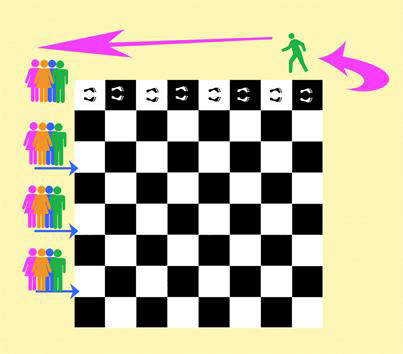
Get four children to stand in front of white squares on the edge of the chessboard. Any one of the 4 sides can be used.
-
Get the remaining children to form 4 lines of approximately equal length behind the first 4 children.
-
On command, the first child in each line crosses to the other side of
the board in a straight line, one square at a time.
-
They change from white to black squares or vice versa using the Castle Step, and without treading on the ‘invisible walls’ (the border between the squares).
-
When the children go from a white square to a black one, they loudly say a polite word while they are on the white square. Only after doing this can they move to the black square.
-
When they go from a black square to a white one, they first let out a scream of anger while standing on the black square. Only after doing this can they move to the white square.
-
Once the first child reaches the other side and leaves the chessboard, the next child in line starts to cross and so on.
-
Once a child reaches the other side they should leave the chessboard and go to the back of their line, going around outside the chessboard
-
Each child should cross the chessboard at least once.
-
At the end of the activity, discuss the experience with them: was it easy to express anger? How did you feel? etc.
-
Demonstrate the activity before the children start.
A SCREAM OR POLITE WORD
Children motion diagram
THE FAIRY TALE
“… Every year, the king organized the Great Ball, which was famous throughout the realm as everyone was invited and it was so much fun - all the guests danced until they dropped from exhaustion. There was an orchestra with a conductor for the dance music. When he lowered his baton, everyone had to stop where they were. The conductor would then cry out either ‘Black’ or ‘White’ in a very loud voice. If you stopped in a room of the same colour as the one announced by the conductor, you had to leave the castle immediately (but everyone then sneaked back in when there was a new conductor!). As the king was always in a good mood for the Great Ball, everyone was allowed to move around the castle as they wanted to (but they couldn’t run as it was a very formal affair) The best part of the game was that the last person left in the castle became the new conductor of the orchestra”
ACTIVITY 4
THE CASTLE’S GREAT BALL
Main instructions for the children
-
Move around freely and spontaneously in the castle, going into a different coloured room with each step.
-
Look at the orchestra conductor at all times.
-
When the conductor’s baton drops to his or her side, stop in the room you are in.
-
If you are on the colour the conductor calls out, leave the castle.
Activity details for the teacher
-
All the children are on the chessboard.
-
Stand outside and to one side of the chessboard with your back to the board, holding a baton up with a raised hand as if you were an orchestra conductor.
-
When the conductor starts to conduct (waving the baton in time with imaginary music), the children begin to move.
-
After approximately 10 seconds, the conductor stops conducting and lowers the baton. At this point, the children must stop immediately on the square they are on.
-
The conductor calls out a colour (e.g. White!) and all the children on a square of that colour leave the chessboard.
-
The game is repeated until only one child remains, who replaces you as the orchestra conductor.
-
The new conductor begins the game again with all the children back on the board.
VARIATIONS:
The children who are on the opposite colour to the one called out leave the chessboard.
The child who becomes the conductor can conduct the orchestra while looking at the chessboard.
When a child is conducting the orchestra, a music recording can be used, which you turn off when the conductor’s baton is lowered.
CLOSING CHANT: Feet in the centre with lots of pep. Now we can do the beautiful Castle Step 1, 2, 3, yeeeeeeah!
OBSERVATIONS
A SCREAM OR A POLITE WORD
This activity allows children to express two states that we all experience: polite kindness and anger.
Expressing yourself verbally in the group provides an opportunity to develop self- confidence and to let off inner tension, which we often suppress.
Predictably, this work on opposite emotions generates contrasting feelings in the child. We will have the opportunity to observe the ability for individual self- expression via the voice, the body and physical contact in a group context. When discussing emotions with the children, it is important to communicate that they are neutral forces that are not necessarily either good or bad. Emotions can arrive suddenly, sometimes like a bolt out of the blue, and we must recognize that we should experience them without fear or judgment, be they our own or of others.
THE CASTLE’S GREAT BALL
The activity focuses on the orchestra conductor’s guidance of the group. We have observed children that enthusiastically accept the role of guiding others and identify well with the part. Some children have difficulty in this role, above all else when the time comes to eliminate a child from the game. In contrast, it is important to observe how children deal with being eliminated from the game.
The conductor plays a key role in the exercise beyond indirectly determining which classmates have to leave, as they also have to reiterate the rules and see that they are respected. This involves checking that no-one is cheating (children can
have problems accepting elimination and some of them sometimes change squares in an attempt to avoid it happening).
Progressively during the game, the children regulate themselves, namely they begin to alert the others and the teacher if somebody has not followed the rules. Becoming the conductor places the child in a symbolic position: they see themselves in a privileged role, which allows them to gain experience with responsibility and guiding the group. At the same time, the group has to accept being guided by a classmate that a moment before was their peer.
The understanding of the different roles that an individual can acquire within the group is important for reinforcing a sense of identity and responsibility for the tasks entrusted to them.
This game activity highlights the concept of moving freely on the chessboard but with awareness of shared space and following the instructions given by the orchestra conductor (multi-focus spatial vision).
There are many resulting benefits:
-
accepting instructions from someone who only seconds before was a peer.
-
accepting elimination from the game and not cheating.
-
learning to take on responsibility and manage others with authority but also diplomacy: How will I feel? Will I have the courage to eliminate my classmates from the game? Will I favour one over another? What will it be like to take the conductor’s baton in my hand? (There are some children who identify with the role, others who are embarrassed or are afraid to make a mistake).

