THE CASTLE PATH
BRIEF LESSON SUMMARY
-
Different ways of doing a single route (the path to the castle in the fairy story)
-
Walking forward, backward, hopping, zigzagging
-
The Castle Step
NB This lesson focuses on developing motor skills that will be necessary for subsequent lessons
EQUIPMENT: GIANT CHESSBOARD – NAME CARDS AND HOLDERS - TAMBOURINE – COLOURED CONES - COLOURED HOOPS
THE FAIRY TALE
“There was only one way for subjects to get to the castle on foot: this was along a single path that the king could see from his window (the king always liked to know exactly who was coming to visit). On the path the king placed small flat bushes (the hoops) as well as conical hats (the cones) that he had bought back from one of his visits to far-off lands. At first, making your way through the bushes and hats in the correct way required lots and lots of concentration, but with practice it became easier and easier ...”
ACTIVITY 1
THE PATH THAT MUST BE TAKEN
NOTE: Prepare the space to be used before the arrival of the children, placing next to the chessboard the cones (small Chinese hats) and hoops (the bushes), which are part of the single route the children will follow (see diagram) in the exercises. The different methods of doing the route (forwards, backwards, etc.) are to be done successively and involve completing the entire route. As with all lessons, you should give a demonstration of the various aspects of an activity to the children. It is advisable to repeat each method more than once, so the children have sufficient opportunity to master the correct execution.
GENERAL REFERENCE DIAGRAM FOR THE 3 METHODS OF DOING THE ROUTE
(the single castle path in the fairy tale)
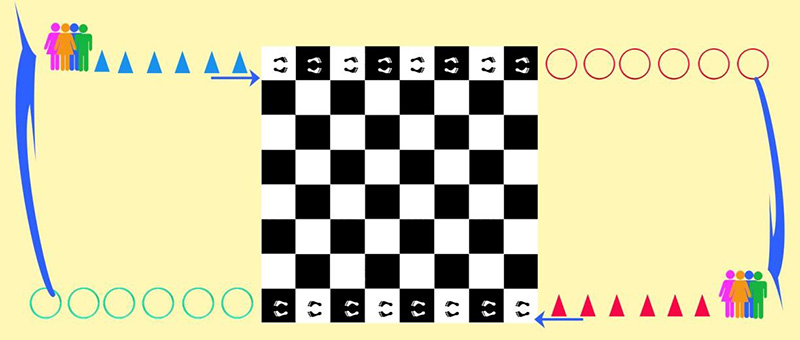
LEGEND:
CONES

HOOPS

CHILDREN IN A LINE AT THE STARTING POSITION

CROSSING USING THE CASTLE STEP

Main instructions for the children
-
Form a line behind the coloured hats
-
Zigzag through the hats as indicated
-
Cross the castle using the Castle Step
-
Hop through the section with bushes as instructed
-
Join the end of the other line
METHOD 1
LEGEND
WALK FORWARD IN A ZIGZAG

WALK BACKWARD IN A ZIGZAG
HOP FORWARD WITH LEGS CLOSE TOGETHER

HOP FORWARD, SUCCESSIVELY CHANGING FROM RIGHT FOOT TO LEFT FOOT
Activity details for the teacher
-
The children form into two lines on opposite sides of the chessboard. They start to move at the same time.
-
The children in the line on the right (see diagram), starting one at a time, walk forward in a zigzag between the cones, and then cross the chessboard doing the Castle Step.
-
When they reach the other side of the board they start hopping into the hoops laid out on the ground with their legs close together, and then join the other line.
-
The second line, also starting at intervals, walks backwards in a zigzag between the cones, then the children turn around to face forward and cross the chessboard using the Castle Step.
-
When the children reach the other side of the board, they hop into the centre of the hoops laid on the ground standing on one leg only, alternating between right and left. When this is finished, they go to the end of the other line.
METHOD 2
LEGEND
RUN FORWARD IN A ZIGZAG
WALK BACKWARD IN A ZIGZAG
HOP FORWARD WITH LEGS CLOSE TOGETHER
HOP FORWARD; RIGHT FOOT – RIGHT FOOT / LEFT FOOT – LEFT FOOT
Activity details for the teacher
-
The first line, with the children starting one at a time, does a zigzag, running forward between the coloured cones and then crosses the chessboard using the Castle Step.
-
Once at the other side of the board, they begin to do forward hops into the centre of the hoops with legs close together. They then join the other line.
-
The second line, again with the children starting one at a time, walk backwards in a zigzag between the cones; they turn around to face forward and cross the chessboard with the Castle Step.
-
Once they arrive at the other side they do hops into the centre of the hoops on one leg: 2 hops with the right leg, and 2 with the left leg.
METHOD 3
LEGEND
ZIGZAG RUNNING FORWARDS
ZIGZAG RUNNING BACKWARDS
HOP FORWARD WITH LEGS CLOSE TOGETHER AND HAND CLAP
HOP FORWARD WITH LEGS CLOSE TOGETHER AND THEN APART
Activity details for the teacher
-
A line of children, starting one at a time, runs forward zigzagging between the cones, and then crosses the chessboard using the Castle Step.
-
When they arrive on the other side, they hop into the centre of a hoop with legs close together, clapping their hands when they hop.
-
The second line, again starting one at a time, must run backwards, zigzagging between the cones, then turn around to face forward and cross the chessboard with the Castle Step.
-
When the children get to the other side, they do two different hops in sequence (both legs close together into the hoop; then legs apart over the space between the two hoops; both legs close together into the next hoop, etc.).
ACTIVITY 2
ROUTE RACE: YEAAAAH! WE FINISHED FIRST!
The scheme:
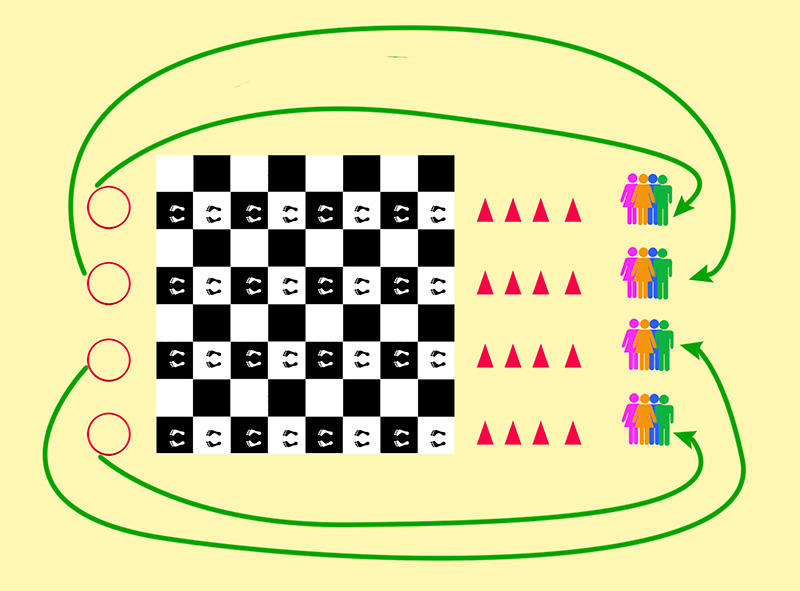
Main instructions for the children
-
Form 4 lines behind the coloured cones
-
Zigzag between the hats as instructed
-
Cross the castle using the Castle Step
-
Quickly hop into the bush with both legs close together.
-
Begin to zigzag between the hats only after the child before hops into the hoop
-
Go to the end of your line by going around the castle.
Activity details for the teacher
-
4 teams are formed in separate lines (see diagram)
-
The first child of each team line passes through the cones as instructed (the 3 methods in Activity 1 can be used successively if the activity is repeated).
-
The children cross the chessboard and hop into the hoop with legs close together.
-
The next child begins to do the route only when the preceding team mate has hopped into the hoop on the other side of the board, and so on.
-
The first team to complete the exercise is the winner.
-
If a team has one less member than the others (odd number of children), the first child does the route a second time after the last of their team mates has completed the route.
-
The winning team is given a round of applause.
CLOSING CHANT: Only one path, but done in so many ways... with bushes and hats, concentration sure pays! 1, 2, 3, yeeeeeeah!
OBSERVATIONS
THE PATH THAT MUST BE TAKEN
The path forms a connection between the space outside and inside the chessboard. This differentiation is of great importance and brings into focus rules relating to the interior space of the chessboard, which are discussed when reviewing the concept of black and white squares – in particular the following:
-
the same square cannot have two occupants.
-
you do not push other children to get a position.
-
you do not go onto the chessboard unless required by an activity. Generally, kids listen to the rules more willingly and recognise them in a more meaningful way if the atmosphere and situation is conducive, e.g. a humorous comment or the physical proximity that forming a circle brings about.
Understanding of rules is the first step towards their acceptance, which is achieved by the teacher creating group involvement and discussion.
THE RULES
Observation of the rules is something the children must focus on and respect for the entire duration of the activity.
This is of fundamental importance as it determines:
-
group discipline throughout the entire game
-
reciprocal respect when there is a contribution to rule enforcement by other classmates.
-
optimize learning of course material and achieving activity objectives.
-
introducing the concept of cheating and honesty in respect to the rules of the game.
-
experience with handling personal frustration created by limitations set by rules or when your team suffers consequences as result of a rule not being respected.
ENFORCING THE RULES
Every teacher usually has their own way of conducting activities based on their own experience, and above all else, on their type of personality.
The two main approaches are: directing and non-directing.
A teacher who directs events strictly will have little difficulty ensuring that children respect the rules, but at the same time they must be careful as to what effect this approach has on the children, especially children that come from domestic situations that are very relaxed regarding rules.
For the teacher that has a looser empathic approach (non-directing) it will be easier to connect with the children emotionally and to see things from their point of view, but they must balance this with sufficient focus on the rules, emphasizing with firmness their importance and indicating clearly that there are consequences if they are not followed, both for the individual and for team mates.

