FORWARD VERTICAL, BACKWARD VERTICAL
BRIEF LESSON SUMMARY
-
Forward and backward vertical movement
-
Forward and backward Castle Step
EQUIPMENT: GIANT CHESSBOARD – NAME CARDS AND HOLDERS – TAMBOURINE - SHEETS OF PAPER (A4) WITH THE IMAGE OF A FLOWER ON ONE SIDE AND A NUMBER ON THE OTHER
NOTE: In this phase of the work, the chessboard is used freely, i.e. the terms used to describe direction are conceptual and not used in the strictest sense. Thus children can use any side of the chessboard as an entrance or exit point for the vertical activities. Use of directional terms in the strict sense occur later with the introduction of the bottom right-hand square (H1), as a reference point. The concept of the front and back of the chessboard will be introduced by BOLETUS THE GNOME in Lesson 6.
THE FAIRY TALE
“The king had a big problem: the castle had long narrow stairways that were very crowded with people going back and forth in opposite directions. Because the stairs were so narrow, there usually was quite a scene: people who bumped into each other, others who brushed past each other rather roughly (sometimes losing a button!), and still others who ended up stopping face to face. The king’s advisor, Boletus – a clever but somewhat funny-looking gnome – decided to intervene. Boletus said that everyone should walk up and down the stairs as they did in his country, which the king visited when he was just a young prince …”
ACTIVITY 1
FORWARD VERTICAL MOVEMENT– PASSING MEETINGS!
The scheme:
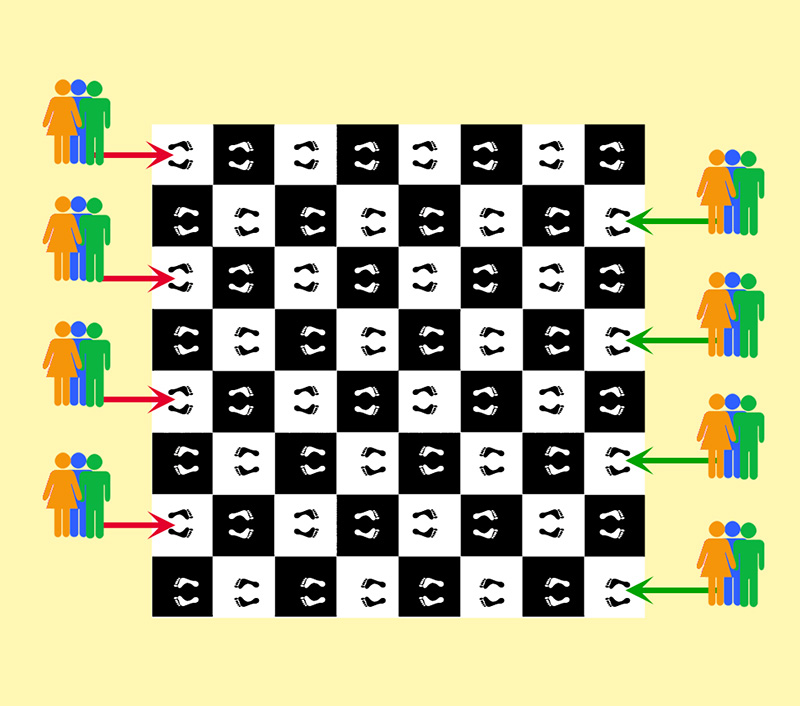
Main instructions for the children
-
From your line in front of a white room, cross the castle using the Castle Step.
-
Do each Castle Step on the beat of the tambourine.
-
Form lines again in front of white rooms on the other side of the castle and repeat the activity going the other way.
Activity details for the teacher
-
The class is divided into 8 groups that form lines outside the chessboard on opposite sides, standing in front of white squares.
-
On the beat of the tambourine, the first in each line goes forward and crosses the chessboard.
-
Each child waits on the other side for everyone in their line to finish, and they form lines again in front of white squares repeating the exercise in the opposite direction.
ACTIVITY 2
FORWARD VERTICAL MOTION – CLOSE ENCOUNTERS!
Main instructions for the children
-
Beginning from a line in front of either a white or black room, cross the castle using the Castle Step.
-
Do a Castle Step with each beat of the tambourine.
-
When you find a classmate in your path, slide past them but without leaving the line of rooms you are moving on.
-
When you arrive at the other side of the castle, go to the back of your line.
Activity details for the teacher
-
-
The class is divided into 8 groups that form lines outside the chessboard on two opposing sides, 4 in front of white squares and 4 in front of black squares.
-
The first 8 children are instructed to start. “What’s going to happen? Won’t we bump into each other?”
-
When a child encounters an oncoming classmate directly in front of them, they must pass the obstructing classmate without leaving the line of squares they are traveling on and not touching - “Children, you’ll have to become really, really thin”.
-
After passing the oncoming child, the crossing of the board with the Castle Step is resumed, with the child leaving the chessboard once across.
-
The second in each line is instructed to start and the activity is repeated
-
Once the children have crossed and left the chessboard, they wait for all the others in their group to arrive in front of the final square they reached (if they left from a white square, they’ll finish on a black one and vice versa).
-
To be done 1-2 times.
-
ACTIVITY 3
BACKWARD VERTICAL MOTION – MEET AND GREET
Main instructions for the children
-
Beginning with either a white or black room, cross the castle using the Castle Step.
-
Do each Castle Step on the sound of the tambourine.
-
When you come face to face with a classmate on your path, stop directly before them and greet them as discussed.
-
Go backwards to where you started from, using a reverse Castle Step.
Activity details for the teacher
-
The class is divided into 8 groups that form lines outside the chessboard on two opposing sides, 4 in front of the white squares and 4 in front of the black ones.
-
The first 8 children start moving forward using the Castle Step, each step is in time with the beat of the tambourine. When the two opposing lines come face to face, they stop and greet each other.
NOTE: Before the activity starts, it’s a good idea to begin by suggesting different ways of greeting each other; you can ask the children if they have greetings they would like to use:
1...say ‘Hi’ (with a wave of the hand)
2...say ‘Gimme 5’ (holding their palm out for a high-five) 3. like actors in a theatre (a bow)
-
-
like adults (shaking hands)
-
with a hug, etc.
-
If there are children from other countries (and you think it is opportune), ask them to say hello in their languages (hi, ciao, salut, etc.) or show greeting gestures from their countries; all the children can repeat these.
-
-
After greeting the child facing them, each child goes backward to the starting square using the reverse Castle Step.
-
The children then leave the board and go to the end of their line.
-
The next 8 children from each line now do the activity.
NOTE: After the entire activity has finished, review with the children that you can move vertically both by going forward or backward and that these two aspects of the vertical have names: FORWARD VERTICAL – BACKWARD VERTICAL.
ACTIVITY 4
TEAM GAME: FLOWER POWER
The scheme:
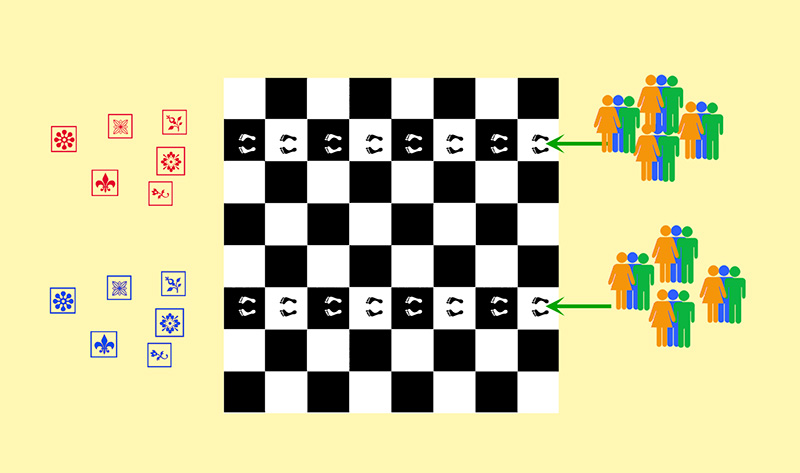
Main instructions for the children
-
Form 2 lines and then cross the castle using the Castle Step, starting with a different foot each new step.
-
When you have crossed, pick up a sheet of paper with a flower, turn it over and loudly call out the number of points that are written; turn the page over again and put it back on the ground where you found it.
-
Go around the castle and go to the end of your line.
-
Only start your turn after the team mate before you has put the piece of paper back on the ground.
-
The same flower can be turned over every time. You are allowed to whisper to other team mates which flowers have the most points before they start the exercise.
-
If the Castle Step is not correctly done, you have to go back and immediately start again.
Activity details for the teacher
-
Before the activity starts, show the children the sheets of paper with the drawing of a flower on one side and a number (game points) on the other. This is an opportunity to talk about the different flowers and discover their names together; where they grow and if they know them.
-
The class is divided into 2 teams that form lines on the same side of the chessboard in front of white squares.
-
Place 6 sheets on the ground on the other side of the board for each line of children, with the flower image facing up. The points written on the 6 sheets are as follows: two sheets with 1 point, two sheets with 2 points, one sheet with 3 points, and one with 4 points.
-
The first child from each line starts to cross the chessboard using the Castle Step. If a child makes a mistake in the execution of the Castle Step, they must return to the starting position and immediately begin again. Once on the other side, they leave the chessboard, select and turn over a flower sheet, and say out loudly the number of points that is written.
-
The child should place the sheet of paper on the ground in its original position, with the flower facing up, and then go around the chessboard to the end of their line.
-
At whatever point you wish, the game is stopped: the team that has the most points at that moment is the winner.
-
Each team should appoint a team captain, who is responsible for organizing the point count, with every child in the team helping.
NOTE: Team members can tell other members who are yet to do the activity which flower sheet has the highest points so as to increase the team’s chances of winning. This is to be encouraged as it stimulates the use of game strategy that is useful at both an individual and team level.
CLOSING CHANT: “Vertical forward! Vertical backward! When we meet, it’s time to greet! 1 - 2 - 3 yeeeeeeah!”.
OBSERVATIONS
CROSSING THE CHESSBOARD
In this lesson the children learn to master steps on the chessboard. It is important to see if there are kids who continue to have problems and to give them further assistance and encouragement, also through physical contact (hand or shoulder). Physical contact of this sort can reduce stress and show teacher trust and confidence; learning will develop via body memory if such moments of brief physical contact are experienced as supportive and inclusive.
THE VERTICAL DIRECTION
The children can review the Castle Step moving vertically; body language that reveals how the child is feeling and coping is chiefly restricted to the upper body (the torso, arms, head and face). How are they holding their arms and hands?
What expressions are they making with their entire face or their mouths?
Some children, for example, put their hands in their pockets, others chew on their bottom lips – others cross their arms. This type of body language indicates tension, concentration, or great effort when crossing the board, and monitoring it is important, as it reveals when there is excessive discomfort or difficulty.
During these sessions children should be asked to adopt positions that demonstrate control and self-confidence (for example, arms parallel with the side of the body).
CROSSING: ONE GROUP FACES ANOTHER
This activity considerably increases awareness of the idea of coming face to face and managing difficulties such as passing other children. Children will frequently take the opportunity to deliberately bump into each other instead of moving out of the way or sliding past because they think it is fun; however, the teacher must emphasize the responsibility everyone has not to hurt each other, and they must find creative and non-aggressive strategies.
In order to foster good relationships between classmates it should be pointed out to the children that when they are required to work in a shared space, as is the case for the classroom and the chessboard, they must always search to find solutions that favour immediate collaboration based on mutual respect.
PHYSICAL AND EMOTIONAL CONTACT.
Normally children have no problems greeting each other verbally or with a physical gesture when asked to, e.g. shaking hands is a gesture they see every day and is an example of routine social communication.
It can be a little more difficult for kids to enter into contact with a kiss or a hug.
With this type of greeting, a more intimate meeting comes into play, as the children allow something that is normally reserved for the family circle or close friends. In general, physical contact creates greater trust, cooperation and fraternal exchange between classmates. Without any pressure of any kind, children can be helped to overcome embarrassment, fear of judgement, and the traditional separation of boys and girls and even the tendency of children of different ethnic backgrounds to group together (there are children who fear contact with children of different ethnic backgrounds and there are others who relate to them easily).
Physical contact is ten times more powerful than verbal and other types of contact. It has an effect on almost everything we do, and is integral to authentic and spontaneous communication. Through play and physical contact, the child regains that original sense of security and belonging that facilitates learning and communication with others.
FLOWER POWER
With this activity, children start to compare themselves through competition: they can experiment with winning and losing but as part of a team and the whole class. Identification as an individual is diminished by group work, the importance of which is always emphasised, with special focus on commitment and collaboration with other teammates.
It is worth stressing that these factors will be important for all the lessons, which are characterized by games conducted in the spirit of fair play and positive comparison of performance. It is underlined that it is our inner attitude that determines good performance and that we can learn from losing, both in game activities and life in general.

