Horizontal and vertical
BRIEF LESSON SUMMARY
-
Forward and backward vertical movements
-
Right and left horizontal movements
-
Sideways steps and manoeuvres
EQUIPMENT: GIANT CHESSBOARD – NAME CARDS AND HOLDERS - TAMBOURINE - COLOURED CONES - HOOPS
ACTIVITY 1
THE LETTERS F AND B ARE DIRECTIONS FOR ME
Main instructions for the children
-
Go into any unoccupied room on the chessboard.
-
When you are told to, or on the beat of the tambourine, go forward or backward as instructed.
Activity details for the teacher
-
Put two lines of differently coloured cones on two sides of the chessboard so as to highlight and contrast vertical and horizontal (e.g. yellow on one side of the chess board, and red along a side of the board that meets it perpendicularly) and bring the presence of the two colours to the class’s attention, but always avoiding using the words ‘vertical’ or ‘horizontal’.
-
The children go to a chessboard square of their choice; if the class is big, divide the children into two groups who do the activity successively.
-
Stand outside the other side of the chessboard to where the activity is taking place and call out letters to guide the children’s movements, which occur parallel to a line of cones.
-
F for forwards, B for backwards. You can call out either letter in succession (e.g. three F’s in quick succession for the children to go forward 3 steps, or two B’s to indicate 2 backward steps).
-
To avoid them leaving the chessboard too soon, ask the children to occupy central squares. When a child leaves the chessboard, they re- enter the board immediately on another vacant square.
-
The movement from one square to another can be done in any way the child wants. Some will do the forward or backward Castle Steps out of habit.
VARIATIONS:
-
The same exercise can be done using the tambourine: a beat on the drum- surface of the tambourine: one square ahead; a beat on the wooden side of the tambourine: one square back.
-
The same exercise can be done with a mix of vocal and tambourine commands.
ACTIVITY 2
LET’S GO SIDEWAYS! INTRODUCTION TO HORIZONTAL MOVEMENT.
The scheme:
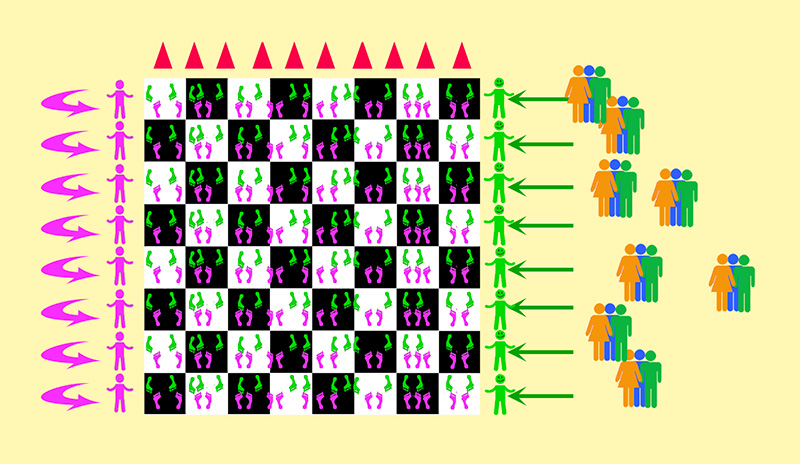
Main instructions for the children
-
Cross the castle sideways using any step you want along the side of the castle with coloured cones.
-
Repeat this several times.
Activity details for the teacher
-
Remove the cones used for vertical reference in the previous activity, leaving the horizontal cones in position (red in the Activity Diagram).
-
All the children start from the same side and cross the board as they wish in a playful manner, starting from any square on the edge of the board. They then come back again.
-
The children must always maintain a sideways movement for the entire return-crossing of the board (parallel to the red cones in the diagram).
-
During the movements the children can either face the cones, or have their backs to them, freely choosing their method of moving across the board.
-
By sideways movement we mean any step involving a lateral movement of the legs (i.e. a hip is pointed in the direction you are going).
ACTIVITY 3
HEY, THIS IS GETTING HARDER!
Main instructions for the children
-
Move sideways across the castle parallel to the coloured cones. You will be told which steps to use.
-
Do the steps in time with the rhythm of the tambourine.
-
After you have crossed the board, come back again, and then go to the end of your line.
-
Repeat the activity when it is your turn again, but facing the other way.
Activity details for the teacher
-
The children form 4 lines at the white squares on the side perpendicular to the side with the red cones in the diagram
-
One child from each of the 4 lines leaves at a time. After completing the exercise, they go to the back of their respective lines.
-
The children move sideways, facing in the same direction both for the first and the return crossing following the various instructions given.
-
The tambourine should provide a rhythm appropriate to the nature of the step used, with the children attempting to adjust their steps to the rhythm used.
-
When it is a child’s turn again, they repeat the exercise but facing the other way to that of the previous crossings. Once again, the children do a return-crossing of the chessboard.
Here are the steps the children use (photos of how the steps are done are at the end of the manual):
-
Sideways Castle Step: One foot enters the centre of the square to the side; the other foot is brought next to it; the first foot to enter goes into the next square to the side.
-
Sideways Castle Hop: The same sequence of moves as the Castle Step but the entrance and exit steps are single-leg hops (as if there were a little obstacle to get over)
-
Sideways cross-step with leg in front: leg in, the other leg crosses in front; the first leg goes into the next square to the side.
-
Sideways cross-step with leg behind: leg in, the other leg crosses behind the other: the first leg goes into the next square to the side
-
Sideways Gallop: Both arms are held straight out to the sides (the shape of a cross) one leg goes to the side, immediately the other one arrives next to it, the other shoots out to the side, creating a type of sideways galloping hop with both feet momentarily in the air at the same time
VARIATION:
One or more children are invited to go onto the chessboard and in turn are told to make a sideways movement (e.g. 2 squares sideways to the right). The others check that the movements are being done correctly (i.e. the number of squares is correct, and that right and left is always from the same point of view). If any of the children have problems with sideways movement, ask them to hold out an arm pointing in the direction they are travelling.
NOTE: After the activity is finished, tell the children that when going in the horizontal direction we can move both left and right, and therefore we will give the two movements different names: RIGHT HORIZONTAL - LEFT HORIZONTAL.
ACTIVITY 4
RUNNING ZIGZAG
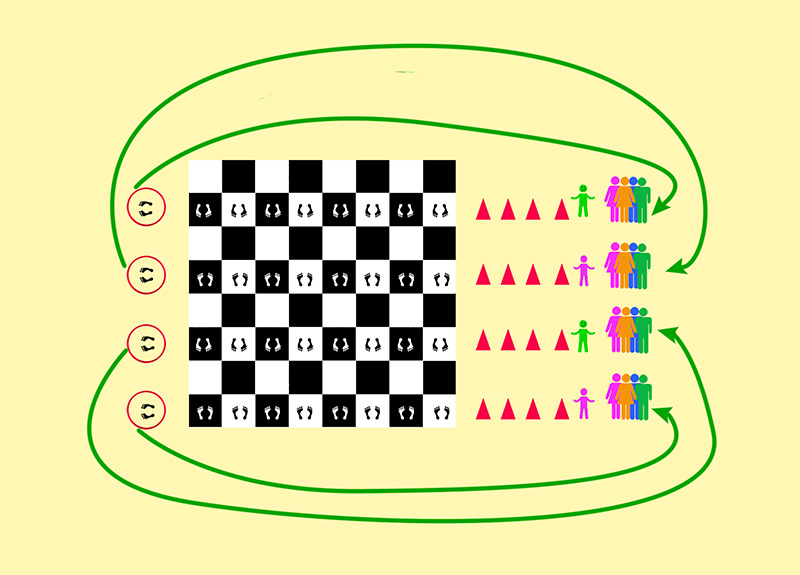
Main instructions for the children
-
Line up behind the coloured cones.
-
When told to, do a running sideways zigzag between the cones facing the castle (the first child of each team starts at the same time).
-
Cross the castle using a Sideways Castle Step.
-
Quickly do a hop into your hoop landing with both feet.
-
Return to the back of your line going around the castle.
-
Start the activity once your team mate enters the hoop, but facing in the opposite direction (i.e. the other hip to that used by your team mate is pointing towards the castle).
-
Your team wins when the last member of your team enters a hoop.
Activity details for the teacher
-
The children form 4 lines behind the coloured cones
-
When told to start, the first child in each line runs sideways through the cones doing a zigzag; all four children face towards the chessboard)
-
They then cross the chessboard with the Sideways Castle Step, continuing to face in the same direction.
-
When they arrive at the other side, they hop into the hoop and then go to the end of their line.
-
The children 2nd in line start when the companions ahead of them hop into the hoop, but they must face in the opposite direction to the 1st team member (the other hip pointing in the direction they are going).
-
This continues for the remaining team members. The activity finishes when all the members of each team have completed the route.
-
The team whose last member enters into their hoop first wins. The other children applaud the winning team.
N.B. In the event that teams do not have the same number of members, a child can repeat the activity (this child will be either the first or last to do it)
VARIATIONS: To liven things up, you can ask the children to use different methods to cross the board: hop sideways with feet together – squatting – 4 sideways hops with the right foot and 4 with the left, etc...).
CLOSING CHANT: “We’ve gone left – we’ve gone right; we’ve learnt horizontal in black and white. 1 - 2 - 3 yeaaaaaah!”.
OBSERVATIONS
REVIEW
This initial review of movements is very useful for the children as it unites the memory of how you move on the chessboard in response to voice and sound signals.
The children must focus on listening, paying attention not only to the work space but external sound signals as well. This promotes dynamic use of the mind in combination with movement, which must be understood and done in a relatively short amount of time.
In addition, the children use a common space that requires paying attention to the movements of classmates, while remembering the simple rules of mutual harmony and cooperation necessary for the game activity itself.
LET’S GO SIDEWAYS! INTRODUCTION TO HORIZONTAL MOVEMENT.
The concept of horizontal movement is introduced in a loose, free way so as to stimulate the children’s creativity and spontaneous experimentation with the various ways of crossing. Only then is it codified with a specific step sequence (the Sideways Castle Step). The initial free approach favours a more dynamic and instinctive learning. In addition, it gives the teacher the opportunity to see if children have mastered the idea of sideways horizontal movement or not, and to give suggestions regarding correct posture for improving balance.

