About Chess
Preparations
Material
- The "The Golden Rules" poster
- A folder for each child
- Nameplates for the children (if they do not know each other before)
- The brochure "The Chess Rules"
- Whiteboard pen
- Fact sheet on CGS and model D
Lesson overview
10 min Introduction (Meeting place)
- Welcome everyone.
- Tell what will happen during the lesson.
- Tell us about CGS and Model D.
- Tell us how chess training works.
- Tell us about the Meeting Place and the Game Tables.
- Explain the rules of conduct that apply when practicing chess: The six rules of chess
15 min Teaching (Demonstration board)
- Tell the story of chess
- Present the chessboard
- Present the demonstration board
- Present the chess pieces
- Tell about "Cross the board"
- Distribute the "Chess Rules"
30 min Play (at the game tables)
- The children can play "Cross the Board"
- The children can play "Cross the Board with kings"
- Have the children put the chess pieces in the box
5 min Rounding (Meeting place)
- Summarize the lesson and what they learned
- Give the children their own folder, which they mark with their name. Let them gather
the nameplates and the brochure "Chess Rules" in it.
- Distribute the information sheets
- Hi, until next week
Chess leader's page
Introduction (at The Meeting place)
It is important to have a clear routine for when the chess lesson begins and ends. By gathering at
The gathering place when the lesson begins or ends, this clarity is achieved.
If you do not know each other before, both students and leaders should have a nameplate for the first lessons. Use the nameplates until everyone remembers each other's names.
When you tell how chess training works, you explain that it consists of:
1. We always start at Meeting place
2. Teaching by the teacher, which takes place at the demonstration board.
3. Chess tasks on paper, which are solved at Meeting place.
Practical exercises, which are solved on the boards at the game tables.
5. Play chess, which happens at the game tables.
6. And of course surprises…
7. The closing always takes place at Meeting place
When practicing chess, there must be a calm in the room, so that everyone can concentrate. Therefore, there is a sign of silence, (Suggest thumbs up, if you do not want to invent your own.) That you can use if someone speaks too loudly and too much.
It is also important that you look at each other as teammates and not as opponents. Chess is a game for gentlemen and gentle women, which means that you never tease anyone or behave badly in any way. There are therefore six golden rules when playing chess that are about how to behave. (Put up the six chess rules on a wall)
Tell them that when you train or play chess, you raise your hand if you have questions. Blir
the children are unsure when they play, they also raise their hand, then the leader comes and helps them.
Teaching (at the Demonstration Board)
1) The story of chess
“Chess is one of the oldest games in the world. It was invented more than 1400 years ago, in the 600s in India.
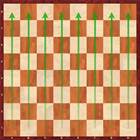
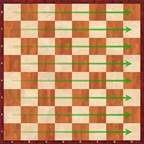
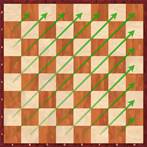
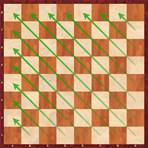
The game was created to train generals in how to place soldiers on the battlefield and manoeuvre out the opponent. So, you are all now generals. If we look at the chessboard, it is also a battlefield in miniature. On one side we have the white army, on the other the black army and then they will make up and see which one is the strongest. On the board there are lines, rows and diagonals. Lines go straight forward and backward, rows go straight to the sides, the diagonals go obliquely.
Lines
Ranks
Diagonales
The game was first called Tjaturanga, which means four parts of the army, but after a hundred years, the game came to Persia, today's Iran and Iraq, and then it got its name. In Persian, king is called 'shah', and you can almost hear how similar it is to the word Chess.
Chess has been important in many cultures. There are several reasons.
First, chess is considered the game of intelligence above others. Anyone who is good at chess is smart.
In chess, there is no luck, ie no dice or any chance cards. It also does not matter if you are a girl, boy, old or young. Everyone can join in and play.
Second, chess has fascinated with its mystery. Of course, it should be possible to calculate from the beginning
how to play a perfect chess game, right? But it's not. Not even today, after 1400 years, when there are computers that are fantastic at calculating, can one know for sure which is the best move in most chess positions.
Thirdly, you can play chess in several different ways. You can play, use it as a trick
and knapsacks or to learn math and programming.
At the highest level, chess is a sport. The professional players train up to ten hours a day.
The World Cup and Olympics are held in all other sports, and doping controls are carried out at the most important ones
the competitions.
2) Present chess
"Chess is a game for two players, who move their pieces every other time. White always starts. The players sit on each side of a chessboard that has 64 squares, 32 white and 32 black. " (Hold up a chessboard.) "Each player has sixteen pieces: a king, a queen, two rooks, two bishops, two knights and eight pawns." (Hold up each piece as you present them.)
3) Present the demonstration board
“In order for me to be able to teach you in a good way, I will use a demonstration board.
It looks like this. You see, it's a big chessboard.” (Hold up a regular chessboard next to it
demonstration board.) ”This is what the king, the queen, the rook, the bishop, the knight and the peasants look like
the demonstration board." (Compare the regular chess pieces with the pieces of the demonstration board.)
4) Present the chess pieces
"Now we'll learn how the plays go." (Put the white king on a box in the middle of the demonstration board.)
"The king goes one square at a time, in whichever direction he wants." (Point to the boxes where the king can go.) "The king is the most important piece of the game, because if you capture the opponent's king, you win."
(Put the rook in the king's place.) "The rook can go straight as far as it wants, forward, backward, or to the sides."
(Point to the boxes where the rook can go.) "Each player has two rooks each when starting a game."
(Put the bishop in the place of the rook.) “The bishop goes obliquely, or on the diagonal as it is called in chess language.
The bishop can therefore only walk on one colour during the entire game. Each player has two bishops when you start, one who walks on the black squares and one who walks on the white squares. "
(Put the queen in the bishop's place.) “The queen walks as the bishop and the rook combined. It can go
either straight or oblique, as far as it wants.” (Point to the boxes where the queen can go.) “If the king is
the most important piece of the game, the queen is the best.”
(Put a knight in the queen's place.) "The horse, or knight as they say in chess language, is a
a little special piece. It goes like the letter L, two steps forward and one to the side. " (Tap the boxes there
the knight can walk.) ”In addition, the knight is the only piece allowed to skip. Look here:” (Put six
white pawns around the knight.) ”Even if the knight is surrounded, it can jump out. Had it been
it would have been stuck in one of the other pieces.”
(Remove all the pieces and put a lone white pawn on the board.) “The pawn is also a little special. It gets
only go one step at a time, except the first time it moves in a game. Then it can choose to go one step
or two steps. The pawn is the only piece that can only move forward - it must never back down. All other pieces must go in all directions. The pawn walks straight but strikes obliquely in front of him. All other pieces strike just as they go, but not the pawn. Look here:” (Set up the following stand on the demonstration board.)
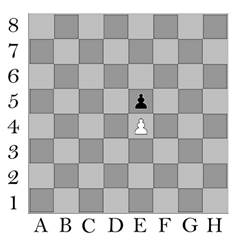
"None of the pawns can move here because they are blocking each other. They're stuck. But if it says like this… ”
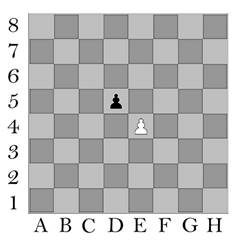
"The player who is on the move can beat the other's pawn." When you play chess, you remove the opponent's piece and put your own on the square.
5) Tell about "Cross the board"
"There is a lot to keep track of when learning to play chess. Therefore, we must take it step by step.
Today we will train the pawn through the game 'Cross the board'. When playing 'Cross the board', the pawns are set up as follows: "(Set up on the demonstration board.)
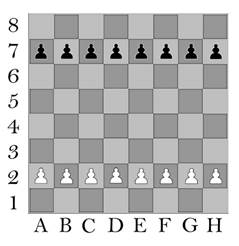
"Do you see that there are numbers and letters around the chessboard. The white pieces are always on the 1st and 2nd rank and the black ones on the 7th and 8th rank. White always starts in chess, so also in 'Cross the board'. Then make black and white every other move. The winner who comes first with a pawn to the other side of the board. So white wins if a pawn comes down here.” (Point to the eighth line.) "And black wins if a pawn comes down here." (Point to the first line.) “Do you remember how the pawn walks? Forward, one step at a time. But the first time the pawn moves, he can choose whether to go one or two steps. The pawn goes straight but strikes obliquely forward. "
Play
“Now you can sit two by two at the chessboards and line up the pawns as on
the demonstration board. But you must NOT start playing. First you must learn the 6 chess rules.
While the children sit down to play, sign
whiteboards:
1. The pawn goes one step further
The first time the pawn moves, he can choose to move one or two steps forward
3. The pawn walks straight but strikes obliquely in front of him.
(When the children have sat down, point to the poster on the wall with the six chess rules)
When you play a game, you try to create a room of concentration, so you can think. Therefore, it must be calm in here. You only talk if it is necessary, and in small, small letters. When I say that you should sit two and two, you do not start playing, but you wait for my signal. Because otherwise it becomes easily messy and difficult to create the room of concentration. In chess, you always show each other respect and we do this by before the game we greet each other (shake hands), and after the game we say thank you for a good game (shake hands). Touched piece and Dropped piece are two rules that work like this. If you have touched a piece, you must move it. Therefore, think carefully before taking in a play. When you touch a piece, you have to move it, but you can often make different moves. When you touch a piece, move it to a square and release the piece, that's when you made your move and it's the opponent's turn. As long as you hold the piece, you can select the square, but when released the move is done. Finally: when you are done with your game, you line up the pieces in the starting position. Not least before you put the pieces in the box when we are going to finish, it is important to make sure that all the pieces are there. Now: Are you ready? Cross the board. Whoever comes over to the other side with one single pawn win. White begins. Then every other move. Start."
1) The children can play "Cross the board"
Give a signal so that all the children start at the same time. Walk around and watch so that the children go right with the pawns. If they finish quickly - let them change colour and play again. Everyone should have time to play one game with black and one with white.
2) The children can play "Cross the board with kings"
When 10 - 15 minutes have passed, ask everyone to stop playing Cross the board, and instead look at the demonstration board. Put up the following position:
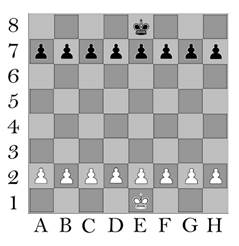
"We will continue to play 'Cross the board', but now the kings will also be involved. There are three ways to win in Cross the board with the Kings. The winner who comes over with a pawn or his king to the other side. But you also win if you take the opponent's king.” (Write on the whiteboard: 1. The king can go one step in all directions. 2. The king strikes as he goes.) Give a signal so that all the children start the games at the same time.
Rounding
When there are five minutes left in the lesson, tell the children to stop playing and to pack up and put the pieces in each box. Say that it is important that they put the pieces in the right box so that there are complete sets in each box.
Summarize the lesson and what you have done.
Distribute the paper "The Chess Rules"
When they are ready, everyone gathers at the Meeting place. The children now get a folder, on which they write their name. In it, they will collect all the material they receive during the chess lessons, this time the paper "Chess Rules" and possibly the nameplate.
Finally, everyone receives the information sheet about the project, which the children can take home. Tell that the information sheet contains contact information for those who lead the chess training in case the children and/or the parents wondering something.
Tell when it's chess training next time.

