The rook and the bishop
Preparations
Whiteboard: (Write the following: The rook: 1. Moves forward, backward and to the sides. How far it wants. 2. It moves and capture in the same way. The bishop: 1. The bishop moves on the diagonal, on the diagonal, as far as he wants. It moves and captures in the same way. You can also draw how the pieces go on the whiteboard.)
Material
· The children's folders (Bring some extra if new students are added.)
· The paper "The Chess Rules"
· Whiteboard pen
· Packagi with rice grains
Copying
· Information sheet about the project (For new students)
· The Chess Rules (For new students)
Lesson overview
10 min Introduction (Meeting place)
· Greet everyone.
· Summary of what happened last time.
· Tell what is going to happen during today's lesson.
· Point that chess is a game for gentlemen and gentle women, repeat the 6 golden chess rules and "The sign of silence".
· When you practice or play chess, you raise your hand if you have questions or are unsure.
· This week's anecdote: Wheat grain story (At the venue)
15 min Teaching (At the demonstration board)
· Repetition of how the chessboard and demonstration board work.
· Presentation of the chess pieces and how they go.
· Repetition of the two variants "First over" and "First over with the kings".
· Show how the rook moves. Show how the bishop is doing.
· Distribute the "Chess Rules" to those who have not received.
30 min Play (At the game tables)
· The children can play Rook against 5 pawns and Bishops against 3 pawns
· The children can play the Rooks against the Bishops
5 min Rounding (Meeting place)
· Let the children put the chess pieces in the boxes.
· Collection at the round table.
· Hello then until next week.
The weekly anecdote
Wheat Grain Story
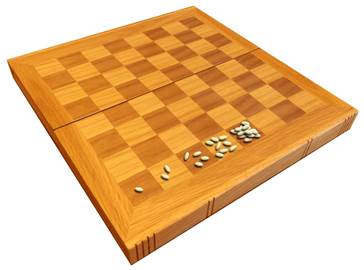
Chess was invented 1,400 years ago in India. Legend has it that it was a clever mathematician who came into the game and showed it to Maharadjan (the king) who ruled the kingdom. Maharadjan loved the game, wanted to reward the mathematician and wondered if he wanted diamonds or gold as a thank you. The mathematician then said that the only thing he wanted as a reward was to get a rice grain on a chessboard on the first square, then double the number of rice grains on the second square, double again on the third, and always double all the way to the 64th and last square. Maharadjan thought it was far too small a wish, and happily accepted the mathematician's suggestion. Was the Maharajah smart or not?
(It is a good idea to divide the children into 2 and then give the couple a chess board and rice grains to try out themselves in practice.)
Answer
One way to present the answer is to draw an 8x8 grid on the whiteboard. In the first box you write 1, in the second 2, in the third 4, in the fourth 8… and so on
"In the first box there will be 1 grain, second 2, third 4, fourth 8, fifth 16, sixth 32…
When doubling, the numbers quickly become large. On the 16th box there are 32,768 pieces, on the 24th box there are 8.39 million. When we get to the last box, the mathematician has got 18,446,744,073,709,551,615 (18 trillion) grains of rice on the board.
If a grain of rice weighs 25 milligrams, there will be a total of 461 billion tons of rice. That is a thousand times more rice than it is eaten in a whole year in the whole world. Another way to explain how much rice there is is that there is so much rice that it covers the whole of England with a one meter thick rice blanket. The Maharajah was simply both deceived and ruined…
Chess leader's page
Teaching (At the demonstration board)
1) Repetition of chess
"Chess is a game for two players, who move their pieces every other time. The chessboard has 64 squares,
32 white and 32 black. Each player has sixteen pieces: one king, one queen, two rooks, two bishops, two
bishops and eight pawns. "
2) Present the demonstration board
“When I teach, I use a demonstration board, which is a large variant of a regular one
chessboard.”
3) Present the chess pieces
Do you remember all the chess pieces? (The children tell.)
"And how are they doing?" (The children tell.)
"What is the most important piece in chess?" (Kings.)
"Why is it most important?" (If you catch it, you win.)
4) Repetition of First over
"Last time you had to play First over."
(Set up on the demonstration board)
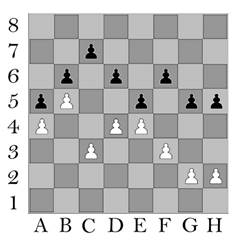
Are there any pawns who can beat each other in this position?” (The children answer.) "Exactly, the pawn moves straight but turns obliquely. That's why it's these pawns…”(you point to the pawns on d4 and e5)”… who can beat each other. However, these pawns can…” (you point to the pawns on a4, a5, b5, b6) ” do not beat each other. Instead, they are stuck, because cannot go straight ahead, or capture obliquely forward.
Do you remember First over? White begins, then makes black and white every other move. It wins that first comes over with a pawn to the other side of the board. Do you remember that first time the pawn moves can it choose whether to go one or two steps? After that, it can only go one step at a time.
Here is another task:”
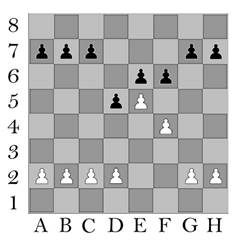
"Which is white's best move?"
Remember that it is enough to come over to the other side with one pawn, then you win. It is therefore important to create an open street for a pawn.
The answer is that white wins by playing 1.f4-f5:
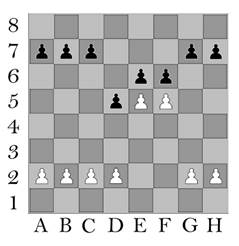
Now black can either play 1… e6xf5 or 1… f6xe5.
If black plays 1.exf5, 2.e5-e6 will come. The pawn has been given a free way down to e8. The pawn can not be stopped. Plays black 1… f6xe5 plays white 2.f5xe6. Again, there is a free way down for the pawn to e8.
Now you put a rook in the middle of the demonstration board.
"Today we will practice how the rook and the bishop go. Do you remember? The rook moves like a plus sign (feel free to show with your arms), horizontally and vertically, as far as it wants. ” Show how the rook moves.
Put a bishop in the middle of the demonstration board.
“The bishop walks like a cross (feel free to show with his arms) how far he wants. A bishop walks on one colour throughout the game.” Show how the bishop is doing.
Play
The children can play Rook against 5 pawns and Bishops against 3 pawns
Sit two by two at the chessboards.” (Set up the following stand on the demonstration board.)
Rook against 5 pawns
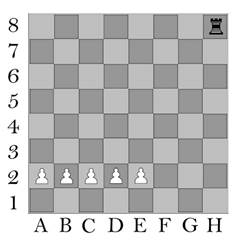
White starts
"Now you will be able to play rooks against 5 pawns. Set up pawns and rooks as on the demonstration board. White begins. If a white pawn comes over to the other side without being hit directly, white wins. If the black rook takes the pawns win black. Do you remember the 6 chess rules? (Feel free to repeat them) Now you can shake hands and start playing.”
When the children have played two games each, once with the rook and once with the pawns, you switch to the next game: Bishops against 3 pawns.
Bishop against 3 pawns
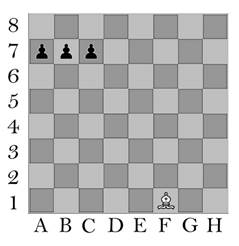
White starts
"Now you will be allowed to play bishops against three pawns. The bishop wins if it takes the three pawns. The pawns win if one of the pawns comes over to the other side, without being beaten immediately.”
When the children have played once with the bishop and once with the pawns, it is time for a task that they are allowed to work on in pairs.
Task (At the demonstration board)
“Now you will work in pairs. Position the bishop and the three pawns so that it is not possible to make a pawn move without a pawn being lost. In other words, a position where the bishop dominates the pawns.”
Answer
Here are two possibilities:
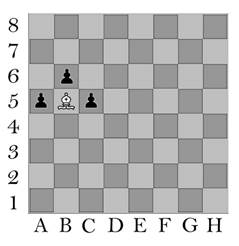
If black is on the move, he / she loses a pawn no matter what move is made.
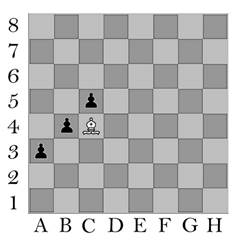
Black will lose all three of his pawns over the next three moves.
If there is time left, the children can play Rook against bishops. This game starts from the following position.
Rooks against bishops
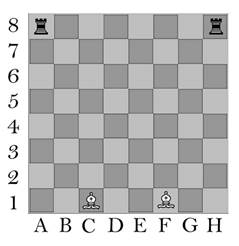
White starts
Whoever first takes one of the opponent's pieces wins.
An additional task to complete after the children have played Rook against Bishops is the following:
Task (At the demonstration board)
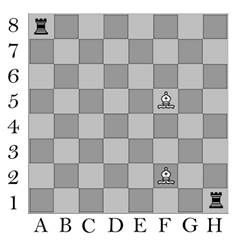
"Find the best move if white moves, or if black moves."
Answer
If white moves, the best move is Lf5-e4. Then white threatens both the black rooks and wins there in the next move. If black moves, there are two good moves. Either Th1-f1 or Ta8-f8. The two bishops are on the same line, so one of them will be beaten in the next move.
Rounding
When there are five minutes left in the lesson, tell the children to pack up and put the pieces in respective box. You gather at Meeting place and the teacher summarizes what the children have learned during the lesson.

