Checkmate – We try ourselves
Material
- Whiteboard pen
Preparations
- Write the following on the Whiteboard:
- GUARD
- CHESS
The three mate questions
1) TAKE
2) FLY
3) IN BETWEEN
MATE PICTURES
Lesson overview
5 min Introduction (Meeting place)
- Welcome everyone.
- Brief summary of what happened last time.
- Tell what is going to happen during today's lesson.
- This week's anecdote: When the queen became the strongest play
5 min Teaching - rehearsal checkmate (Demonstration board)
- Checkmate - what is it?
- Guard - check
- The three mate questions
- Mate pictures
15 min Solve tasks in pairs.
- We create our own mate pictures
15 min Mate with two rooks
15 min Game with mate and judging
5 min Rounding (at the round table)
- Have the children put the chess pieces in the drawers.
- Collection at the round table.
- Tell that next time will be the first checkmate / programming lesson
- Hi then until next week.
The Weekly Anecdote
How the chess queen became the strongest piece
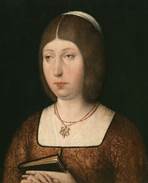
Isabella of Castile
When chess was invented 1,400 years ago, the idea was that the pieces would resemble soldiers and generals on a battlefield. Therefore, at first, there was no queen, instead the king had an adviser, a vizier by his side. The visor was a piece that only had the task of defending the king and was only allowed to go one square at a time on the diagonal. It was thus by far the worst piece on the board.
When the game of chess came to Europe in the ninth century, the names of the pieces were changed and instead of looking among soldiers and the military, it became the more civilian name that reflected society: king, queen (queen), rook, bishop, knight and pawn. The queen, however, was still the worst play.
In the 15th century, chess began to become popular in the court, and was played in all the royal houses. Now some tough queens came forward, first Isabella of Castile in Spain. She lived in an equal marriage with her husband Ferdinand II and is best known for supporting Cristopher Columbus' trip to America, but what she also did was make the queen the best play in chess. She became so angry at chess where the king was the most important play and the queen the worst, so she forbade chess unless the queen became the best play. And so, it became. In 1492, Isabella was behind a book by the chess master Luis Ramirez de Lucena where he establishes how the pieces go (as they do today) and where the queen is the best piece. These rules spread across Europe and were supported by Elizabeth I of England and Catherine the Great of Russia, who were also queens in power.
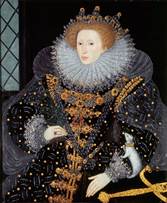
Elisabeth I of England
Repetition Checkmate
Put up the following position
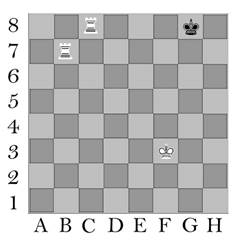
Go through the three mate questions to check if it is checkmate. Then insert a bishop on g7.
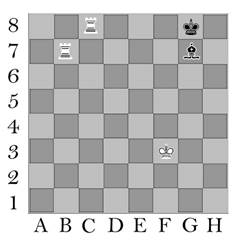
Is it checkmate now? No, the bishop can go between on f8 and the king can escape to h7.
We create our own mate pictures
Pair the children two and two at an empty chess board.
“Now you will be able to create your own mate pictures. Bring out a black king, a white rook, a white bishop and a white knight and place them next to the empty chessboard. Now you are going to create a mate image where the black king is checkmate. Remember to guard first and give check later”
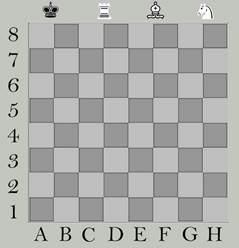
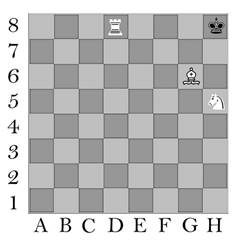
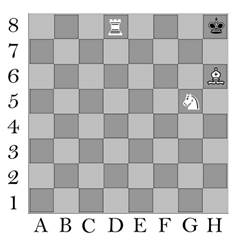
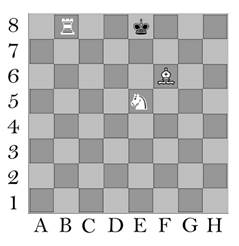
If groups are not able to create a mate image, you can give a hint that “a king in the centre can make eight different moves, a king in a corner can make three moves. Where do you think it is easiest to create a mate image? It is difficult to make checkmate when the king is out on the board because you must guard many squares. Therefore, one usually first tries to get the king down to a corner, or at least an edge. For those who quickly find a solution, you can give an extended task: How many different mate pictures can you find? Below are some possible mate pictures:

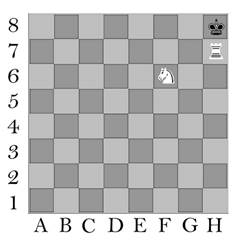
Exercise 2
Put up the following stand on the demonstration board. Ask all the children to put it on their boards.

Now you must put out a white king, a white knight, and a white pawn: KNP so that the black king is in checkmate. How many mate pictures can you find?
There are four mate pictures. In all, the pawn guards the g7, h8 field. The king must guard the pawn and the knight must check. The king can stand on h6 or on f6. The knight can check from h6, f6 or e7. Here is a mate image:
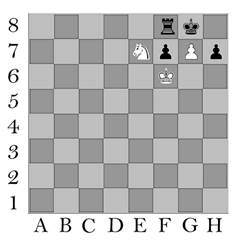
Checkmate with two rooks
Put up the following position on the demonstration board.
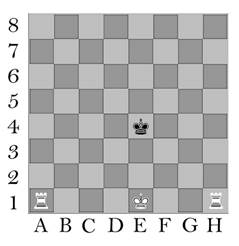
Now we will practice how to play your way to checkmate. The first thing to do is to think about what the mate image should look like. We've seen a mate picture before. This:
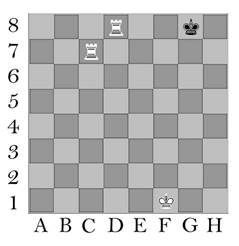
A rook guards, a rook gives check. The king stands at the edge so the king cannot back away.
But how do we achieve this mate position? The first is to push the king to an edge, and how to do it. Yes, you should use "Watch - Shackle the trick". Like this:
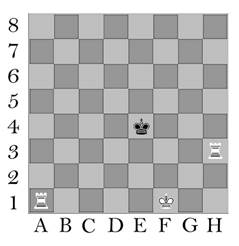
White begins by putting out a guard along the third row. In the next move, the second rook should check, and then they change tasks until it becomes checkmate. (Show how the rooks change tasks. The king goes straight back and finally you reach a mate stand on the last row.)
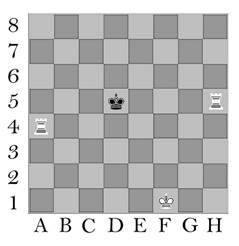

But now the black king was kind and went straight back all the time. Instead, it should approach one of the rooks. Then it becomes more difficult. One way to explain what is happening now is to tell us that in chess there are two types of pieces: the long distances and the melee pieces. The long distances are the queen, the rooks and the bishops. They like to walk far across the board, have open lines and diagonals, and stand far away from the opponent and threaten. Then we have the melee pieces, the king, the knight and the pawns. They must stand close to the opponent to threaten. On the board we have the rooks that are long-distance and the king who is a melee. This means that the king wants to stand close to the rooks and the rooks want to be far from the king.
Therefore, the king should not go straight back when it is pushed back but approach one of the rooks. In the starting position it therefore does this: 1.Rh1-h3 Ke4-f4 2. Ra1-a4 + Kf4-g5
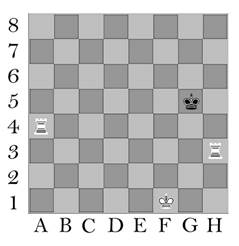
Now the rook can not go to h5, because the king of g5 can then beat the rook. The melee king has come close. Instead, the rook must change sides and get as far away from the king as possible. The best feature is Rh3-b3.
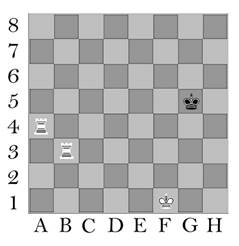
It is better to go to b3 than to a3, because the two rooks can now cooperate, and then they do not "go on each other's toes". Instead, they now form "a staircase" that they can walk up and push down the king against the edge, by switching between guarding and chess. In the next move comes Rb3-b5 +, then Ra4-a6 + and so on. If the king gets too close, the rooks change to the other side.
Play
Now you will have to play once with the rooks and once with the king to practice putting mate with two rooks from this position:
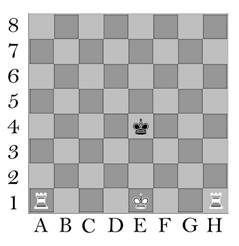
When everyone has been allowed to play once with white and once with black, it's time to play REAL chess, with all the rules and with a checkmate.
Arrange the pieces in the starting position. We play with judging after 10 min. If it has not had time to become a checkmate, then the one who leads wins by 5 points or more.
The children sit down in pairs. Start.
Rounding
• Have the children put the chess pieces in the drawers.
• Collection at Meeting place.
• Tell us what happens next.
• Hi then until next week.

