Test and games with judging
Preparations
- Copy stencils with the test
Material
- Whiteboard pen
- Stencils with tests for all children
- Ruler or tape measure
- Stencil with the value of the pieces to put up on the wall
Lesson overview
5 min Introduction (Meeting place)
- Welcome everyone.
- Brief summary of what happened last time.
- Tell what is going to happen during today's lesson.
- This week's anecdote: Chess as tricks and tricks
15 min TEST
- Test on what we have learned
10 min Who can build the tallest rook?
- 2 + 2 Use the white and black pieces in a set
5 min We learn judging
- How do you play with judging?
- The world's best chess trick
20 min Play with judgment (at the game tables)
- The children can play with all the pieces. You win if you take the opponent's king.
- After 8 minutes, the teacher breaks the game, and a decision is made if one of the kings has not been taken.
- After the first round, the teachers pair the winners and losers.
5 min Rounding (at the Meeting place)
- Have the children put the chess pieces in the box.
- Collection at the round table.
- Hi then until next week.
The Weekly Anecdote
Chess as a brain exercise
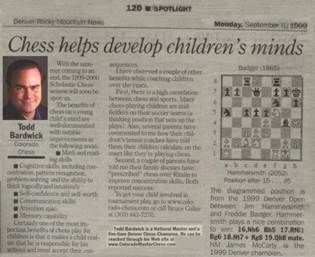
Perhaps you have seen that newspapers often have a chess column. In fact, the game of chess became popular when newspapers became popular.
At the end of the 19th century, industrialism emerged. This meant that many people moved to the cities to work in factories in industry, instead of working in agriculture in the countryside.
Before industrialism, we had a feudal society with the king and queen at the top and then a nobility that decided most things, and so did the pawns. With industrialism, a new so-called class emerged, the bourgeoisie. They were the ones who lived in the cities, owned factories, shops or other companies and who made money. The world had also begun to become more international with trade between countries and the citizens needed to know what was happening. In the newspapers, the citizens got the news they requested, because there were no computers or even telephones. But a newspaper could not only consist of news, but they must also have some entertainment and tricks and gimmicks. Here, chess fit in perfectly and it became very popular to have a so-called chess diagram where the task is to find the best move. Then the answer is either at the end of the article, or on another page in the newspaper. And so it has been until today. Chess as brain exercise, is almost as popular as playing games.
Test 1 CGS
(Circle the right answer)
Question 1
When was Chess Invented?
1) 4,000 years ago
X) 150 years ago
2) 1,400 years ago
Question 2
Which rule is NOT included among the six chess rules? (Circle the wrong rule)
- Play calmly
- The teacher controls
- Say Hi before the game and Thanks afterwards
- Always stand up when making your move
- Touched piece
- Dropped piece
- After the game – put up the pieces.
Question 3
What does "En Passant" mean?
1) In passing
X) In the driver's seat
2) In the window frame
Question 4
A pawn goes over to the other side of the board. What then?
1) Nothing
X) The pawn can be put where he wants in the board
2) It turns into a queen, a rook, a bishop or a knight
Question 5
Can white castle in the position below?
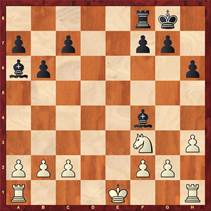
YES NO
Question 6
How many black pieces does the white bishop threaten?
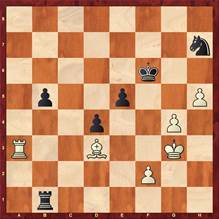
1) 2
X) 3
2) 4
Question 7
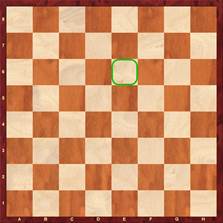
The name of the square?
1) e6
X) e5
2) f6
Question 8
Can the white queen move to b7?
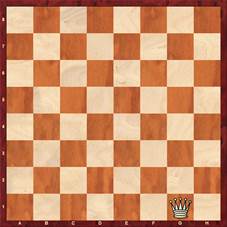
YES NO
Question 9
How many black pieces do white threaten to capture in the next move?
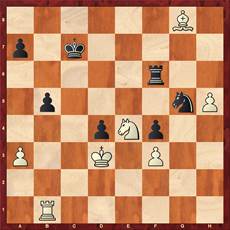
1) 2
X) 4
2) 7
Question 10
How many moves can a knight make from a corner?
1) 1
X) 2
2) 3
Answers
Test 1 CGS
Question 1
When was Chess Invented?
2) 1,400 years ago
Question 2
Which rule is NOT included among the six chess rules?
"Always stand up when you make your move" does not exist
Question 3
What does "A passerby" mean?
1) In passing
Question 4
A pawn goes over to the other side of the board. What then?
2) It turns into a queen, a rook, a bishop or a knight
Question 5
Can white do rocking in the position below?
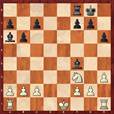
NO
Question 6
How many different pieces does the white bishop threaten?
X) 3 pcs: The rook on b1, the Springer on h7, the pawn on b5
Question 7
What is the name of this box?
1) e6
Question 8
Can the white queen go to b7?
NO
Question 9
How many different pieces can white knock out in his next move?
X) 4: The rook at f6, the Springer at g5, the pawn at b5 and the pawn at d4.
Question 10
How many moves can a knight in one of the corners make?
X) 2
Teaching
Testing
Distribute the stencils. Explain that they will now be given tasks to repeat what you have learned. You will not give points or report results. Let the children work one by one. Review the answers with the group when everyone has submitted the test.
Who can build the tallest rook?
Pair the children in pairs. The task now is for them to build as high a rook (ie not a chess rook, but a "building") as possible on a chessboard with the white and black pieces in five minutes.
Judgment
Start by talking about the value of the pieces. First, the king is invaluable, because it's all about it. Because if you capture the opponent's king, you win, if you capture your own, you lose. The queen is worth 9 points, the Rook is worth 5 points, the bishop 3 points, the knight 3 points, the Pawn 1 point. So, all the pieces count in pawns, one might say, because it is worth a point. These are real values. If, for example, we have a rook, a bishop and a pawn, it usually weighs evenly against a queen. 5 + 3 + 1 = 9. It also means that if a bishop can take a rook, but himself is lost, this can help when you think. For example, if it says this:
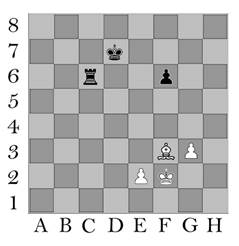
If the white bishop takes the black rook, the bishop will be lost, because the king can take it. Should you do it anyway? Of course, you should! The bishop is worth 3 points, the rook is worth 5 points. White earns 2 points.
Once you have learned what the pieces are worth, you can play a game of judging. You should be allowed to do that now.
Play
You sit in pairs and get ready for games. You win if you take the opponent's king. But after 8 minutes I will stop the parties. If someone leads by 5 points or more when the game is broken, that player wins. Otherwise, it will be a draw, or a draw as they say in the language of chess. How do you calculate it? Well, you count the pieces that are left on the board. How many points does white have? How many points have black? Then you compare. Look here:
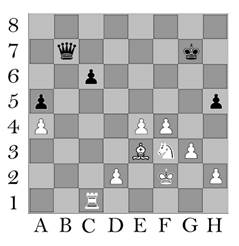
The kings do not count, they are invaluable. White has a rook 5 points, a bishop 3 points, a knight 3 points, and six pawns 6 points. It gives a total of 17 points. Black has a queen 9 points, and three pawns, three points. It gives a total of 12 points. 17 - 12 gives 5 points. Vita leads with 5 points and therefore wins the game.
A trick when it comes to judging is this:
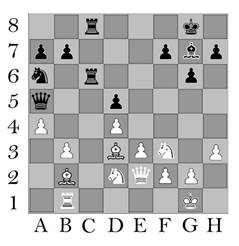
Now there are a lot of pieces left on the board and maybe it is difficult to calculate. What you can do then is to use set-off. You simply remove the same pieces on both sides. In this position you can set off the queens, each their rook, each their bishop, each their knight and six pawns. Then it will be like this:
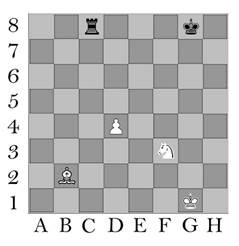
White has 3 + 3 + 1 points. Black has 5 points. White leads by 2 points, but it takes a lead of 5 points to win. The game is a draw, a draw.
The children can play 1-2 games with judging, depending on what there is time for.
Rounding
When there are five minutes left in the lesson, tell the children to pack up and put the pieces in each box. You gather at Meeting place and you summarize what the children have learned during the lesson.

