Checkmate: How does it work?
Material
- Whiteboard pen
- Paper for answers to tasks
Preparations
Write on the whiteboard: "The three carpet questions"
1) CAPTURE
2) RUN
3) IN BETWEEN
Write on the whiteboard:
1) GUARD
2) CHECK
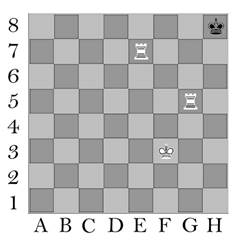
• Set up the following positions on a long table, without chairs around it. You should be able to walk around the long table. Give each board a number 1-5 (place a note next to each board).
1)
2)
3)
4)
5)
Lesson overview
5 min Introduction (Meeting place)
• Welcome everyone.
• Brief summary of what happened last time.
• Tell what is going to happen during today's lesson.
• This weekly anecdote: Napoleon and the escape plan
20 min Percussion chess
5 min Teaching (Demonstration board)
• Checkmate - what is it?
• Guard - check
• The three mate questions
20 min Solve tasks in pairs.
Go through together at the table.
5 min teaching
Stalemate and checkmate
5 min Rounding (at the round table)
• Have the children put the chess pieces in the drawers.
• Collection at the round table.
• Tell that next time will be the first checkmate/programming lesson
• Hi then until next week.
The Weekly Anecdote 7
Napoleon and the Escape plan
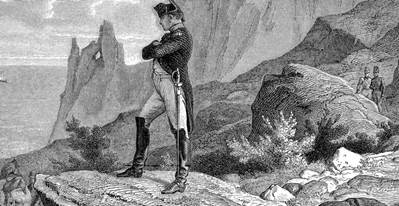
In 1814, Napoleon was forced to resign as Emperor of France. He was exiled to the island of Elba ten kilometres off the west coast of Italy. Half a year later, however, he managed to escape, gather an army and return to France, where he regained power. Other European countries, however, wanted something else and at the famous battle of Waterloo on June 18, 1815, he was defeated once and for all. This time they took the safe for the unsafe and sent Napoleon to the small island of Saint Helena 1850 kilometres outside West Africa. Now he would not be able to escape anyway, would he?
No, he did not, but it could have happened. A very advanced escape plan with the help of a submarine was developed by his friends in France and was to be delivered to him. But how would Napoleon get the escape plan when everything he received was checked very carefully? What they did was carve out a game of chess, but in one rook they drilled holes and laid down the escape plan. Now the chess game would be delivered to Elba. Unfortunately for Napoleon and his friends, the person who was to deliver the chess game on the trip to Saint Helena died, telling the secret about the escape plan in one of the rooks. Napoleon thus received the game of chess, but no more instruction, and during the last years of his life he played every day with a game of chess that could get him free if he only knew its secret.
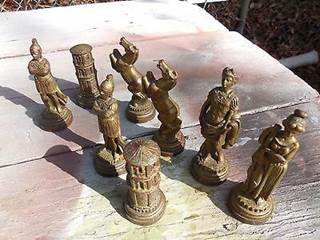
Play – Loser´s Chess
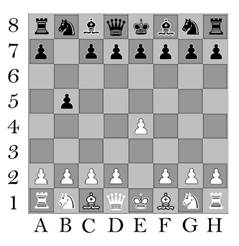
In battle chess, the one who gets rid of all his pieces wins. There is nothing special about the king, it's just trying to get rid of it just like the other plays. When playing Loser´s chess, you MUST capture an opponent's piece if you can. For example after 1.e2 – e4 and 1… b7 – b5:
Now it's white to move, and then the bishop on f1 must beat the pawn on b5. Black still cannot beat any white piece. The game can therefore continue like this. 2.Bf1xb5 c7–c6 3.Bb5xc6.
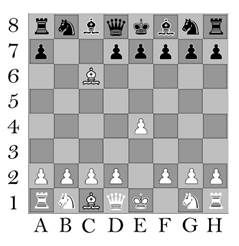
Now, on the other hand, black can capture the white bishop with the knight with Nb8xc6 or with d7xc6. Black chooses. So, the game goes on until someone gets rid of all their pieces, or until someone can make no move. Then you count how many pieces the players have left. The one with the least number of pieces wins.
Teaching – Check mate
Chess was invented at a time when kings ruled. This meant that when those who invented chess came to the king and said: "We have invented a game where you win by beating the opponent's king", the king became angry and banned the game. Oops, here you have invented the world's best game and you must not play it. Then they realized that you win if you capture the opponent's king so that it is eliminated in the next move. Then the game ends immediately, before the king is defeated. The king could agree to that. Therefore, you play with checkmate, which means "The king is dead" or "The king is captured".
What then is check mate in a game?
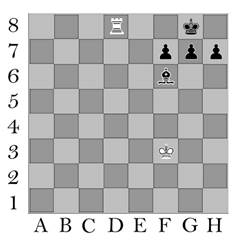
Look here:
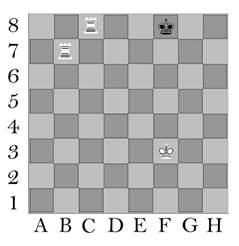
White has just played Tc2-c8. Now the white rook on c8 threatens to take the black king on f8. The king is in chess. But in addition, white has a rook on b7 that guards the black king. This is important when learning to play chess. First you must GUARD the opponent's king so he cannot move. Only then should you give a check. So, LOOK first and MOVE later.
As soon as a king ends up in chess, you must check if it is checkmate or not. This is done with the three carpet questions.
The first question is whether one can CAPTURE the piece that threatens the king. This is the most important question, because most people like to give chess, but often forget that they themselves can be taken. In this position, black only has the king left, so it cannot take the rook on c8.
The next question is whether the king can FLY away from chess. Since there is a guard on b7, the king on f8 cannot take a step up. In addition to saying guard, you can also say that you are building a wall in front of the opponent's king.
The last question is whether one can place any piece IN BETWEEN the play that threatens the king and the king.
Solve exercises in pairs
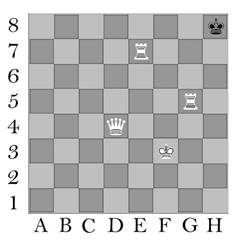
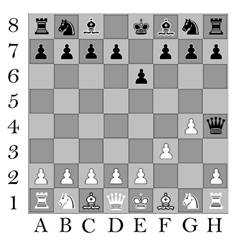
Divide students in pairs. Give them a piece of paper per group where they will write down in which positions on the longtable it is checkmate. The groups can walk around the long table with the stands. Afterwards, you stand on one side of the table and gather the students on the other side in a semicircle so they can see the boards. Feel free to use a whiteboard pen as a stylus for which piece you are discussing. For each position, you ask if it is checkmate or not. Then you go through the three checkmate questions together and check them out. The last task is clearly the most difficult one because it is NOT checkmate but STALEMATE.
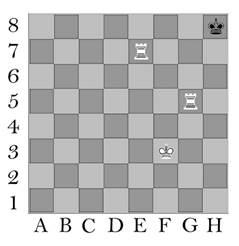
You can explain that one reason why it is a bit difficult with understanding checkmate is that there is also stalemate. If it is black to move in position, white has managed to GUARD the black king, but it is not threatened, it is not in check. Black can therefore not make any move. What then? Well, then it will be a draw, or draw, as they say in the language of chess. But is not this unfair? Why not just win white? Well, because stalemate is the last chance. What if a player knocks out all the opponent's pieces? Then you could give up immediately. But now you have a small chance, that the opponent freaks out, that the opponent guards too much. Stalemate is the last chance.
There are two things that are important when it comes to stalemate. If it's white on the move then it's not the paw, because white can cancel the paw by, for example, playing Tg5-d5. Black can now play Kh8-g8 and then it will be checkmate with Td5-d8.
If black had a different piece to move than the king, it would not have been a stalemate either.
Rounding
- Let the children put the chess pieces in the boxes.
- Gathering at the meeting place.
- Summarize the lesson
- Tell what happens next time
- Bye till next week.

