We learn all the chess rules
Preparations
- Assemble several tables into one long table. There should be no chairs around the table.
- Arrange the boards so that every other has white, and every other black, in one direction. There should be a board for two children in the group. Put the pawns in the starting position on each board.
Material
- Whiteboard pen
Lesson overview
5 min Introduction (Meeting place)
- Hi to everyone.
- Short summary of what happened last time.
- Tell what is going to happen during today's lesson.
- This week's anecdote: Napoleon controls his pieces
10 min Teaching (Demonstration board)
- Farm transformation
- En passant
- Castle
25 min Game - Action Chess
15 min - Mini-game: Play home the pieces
5 min Rounding (at Meeting place)
- Let the children put the chess pieces in the boxes.
- Collection at the round table.
- Tell that next time will be the first chess mat / programming lesson
- Hello then until next week.
The Weekly Anecdote
Napoleon controls his chess pieces
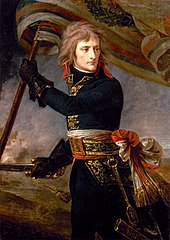
One of the most important generals in history was Napoleon Bonaparte, who was emperor of France from 1804 to 1814, and for a hundred days in 1815. Under Napoleon's leadership, the French army was long considered invincible, and the reason was that he was a chess player. Napoleon played a lot of chess, both with court ladies, generals, and chess enthusiasts. It is even said that one stroke was delayed because Napoleon first wanted to play an exciting chess game.
In addition to training his battles to plan his battles through Napoleon, he took it a step further and divided his army into units that were given their own names. When the battle was about to begin, Napoleon stood on a hill next to the battlefield with large flags. With the flags, he could then control his units and regroup them like chess pieces depending on the strategy used by the opponents. It was only when the English copied Napoleon's strategy that he could be defeated.
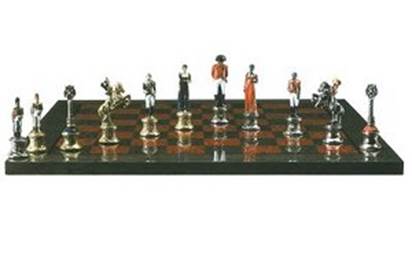
Chess set with Napoleon's army
Chess leader's page
Teaching
Pawn transformation
In pawn chess, the pawn turns into a queen or a rook when it reaches the last rank on the other side of the board. In real chess, the pawn can be turned into any piece, and since the best chess piece is the queen, it is almost always a queen you let the pawn turn into. Here's how: "(Put up the stand on the demonstration board.)
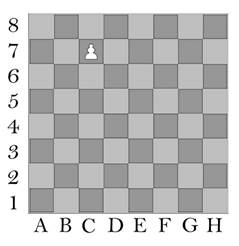
“When you go down with the pawn to the last rank, you change the pawn directly to a new piece, normally a queen, because it is the best piece. Like this:"
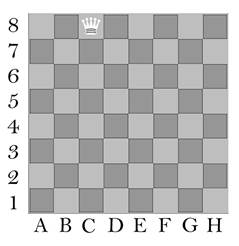
“You can change the pawn to a queen even if the queen you have from the beginning in the starting position remains on the board. What you can do then is to borrow a queen from another chess set. Remember to put the borrowed queen back in the right box after the game. Not least if you turn all your pawns into ladies, it's important. Then you would have nine ladies on the board. "
En Passant
“En Passant is a special move that happens very rarely. En Passant is French and means in passing. The move goes like this:
You know the pawn goes straight and strikes obliquely in front of him. But, when a pawn goes two steps and comes up alongside a pawn, he can be beaten. Like this:
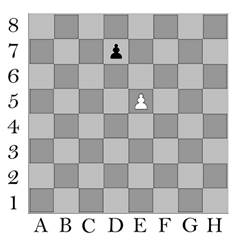
Black to move
Black is now taking the pawn two steps forward. Like this:

Now the white pawn can beat the black pawn, as if it had only gone one step. Like this:
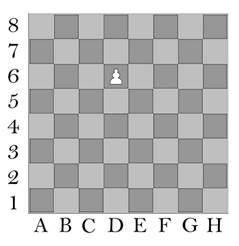
White has made an En Passant. What you must keep in mind is that you have to capture the pawn immediately when it comes up beside the other pawn. Also, if the pawn had only gone one step and come up side by side, then you cannot beat the pawn either.
Castle
"The king is the most important piece in chess because you win if you take it. Therefore, it is important to attack the opponent's king, but also to defend his own. Now you will learn the most important trick to defend your own king: castle. You can castle when there are no pieces between the king and one of the rooks. You take two steps with the king towards the rook and jump over the king with the rook.” (Show short castle on the demonstration board.) "This is short castle." (Put the king back on e1 and the rook on h1.) “It is called short castle, because there are only two squares between the king and this rook. If you castle in the other direction, there are three squares between the king and the rook, and it is then called too long castle. Again, you take two steps with the king towards the rook and jump over the king with the rook.” (Show on the demonstration board.) "There are some rules for whether you can castle: 1) The king or the rook must not have moved earlier in the game. 2) The king must not be threatened, stand in chess as they say in chess language. 3) The king must not end up in chess or pass a square that one of the opponent's pieces threatens. Look here." (Put up the following position.)
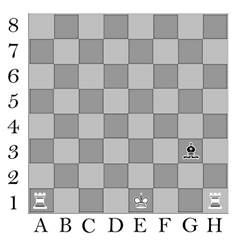
Can white castle now? No, the king is in chess.” (Put up the following position.)
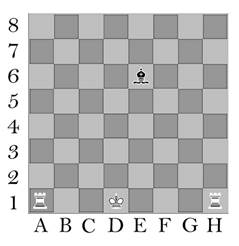
"Now then? No, the king has moved from e1 to d1, so white must not castle in any direction. And finally."
(Put up the following position.)
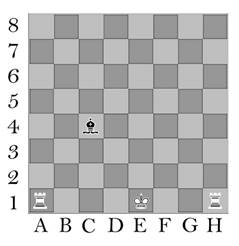
Can white do castle in both directions? No, just long castle. Because if white tries to make short castle, the king passes the square f1, which the bishop on c4 threatens. (Go to the whiteboard.) “If we speak chess language, you write castle in a slightly special way. Short castle is written 0-0 and long castle is written 0-0-0. " (Write on the board.) “To make it easier to remember, you can say that you are writing down the footprint of the rook. For short castle the rook goes two squares, for long castle the rook goes three squares.
Action Chess
Divide the children into two equal teams. Arrange them on each side of the long table so that everyone has a board in front of them and an opponent. At each board, place a white and a black plastic piece from the demonstration board. The leader draws a large T on the whiteboard for the calculation of points. The first task for the team will be to come up with the best name for the team. They get 30 seconds. The leader writes the names of the teams on each side of the top line in the T and gives a point to the team that the leader thinks came up with the best name. Now the children will play "First over". But after a while, the leader says "Action". Then the parties stop. You show who is on the move by inserting the plastic piece from the demonstration board with the same color as the one on the move to show those who come after. Then both teams take a step to the right, to a new board and opponent. (Because they are facing each other, they go in different directions. Whoever takes a step to the right and comes outside the edge of the long table may go back and take the place that became vacant at the beginning of the team.) The players remove the plastic piece in the middle of the board, and so they continue the game. This means that all team members play all the games together!
When someone wins their game, they shout the team’s name. The leader draws a line under the name of the team. The two whose game was finished line up the pieces in the starting position and start a new game. This continues until the leader breaks.
Homecoming Chess
Arrange the white pieces, in addition to the pawns, on the first rank, and the corresponding ones with the black ones on the eighth. The important thing is that no piece should stand on the square it stands on in the starting position of a chess game. For example, you can put them up like this.
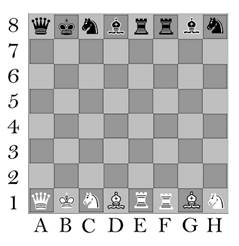
Now white and black will play the pieces back to the starting position of a chess game. The pieces go as usual. However, none of the players may cross the centre rank, 4-5, with their pieces. Thus, kings can stand in chess and pieces cannot be knocked out. White starts as usual and then the players make every other move. Since white has an extra feature, white should win this at the correct game, and therefore black should not be a copycat that does exactly the same as white.
After the game, it is good to have a discussion on how to think in order to play well. A trick is to make free so that the rooks can go out to the corner squares in one move, and that the other pieces try to reach their square in two moves. In the position above, it takes 17 moves to get to the starting position at the best game.
Rounding
When there are five minutes left in the lesson, tell the children to put the pieces in respective box. You gather at Meeting place, and you summarize what the children have learned during the lesson.

