The Queen and the Knight
Preparations
Material
- Whiteboard pen
- Performance card for the Disco duel
Lesson overview
5 min Introduction (Meeting place)
- Welcome everyone.
- Brief summary of what happened last time.
- Tell what is going to happen during today's lesson.
- This weekly anecdote: Every square has got a name
10 min Teaching (Demonstration board)
- The knight
- The queen
25 min Play (at the game tables)
- The children can play queen against eight pawns + task
- The children can play the Disco Duel
5 min Teaching (The children at the boards. The leader at the demonstration board.)
- Repetition of how all the pieces move
- Show how the pieces are put in the starting position
10 min Play (at the game tables)
- The children can play with all the pieces. You win if you take the opponent's king.
5 min Rounding (at the round table)
- Have the children put the chess pieces in the box.
- Gathering at Meeting place.
- Explain that next time will be the first programming lesson
- Hi then until next week.
The Weekly Anecdote
Every square has got a name
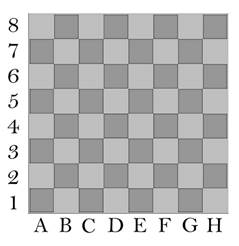
Before chess was invented, people in India wanted to train their soldiers on how to walk and stand on a battlefield, and therefore they had to find a way for the generals to control them. What they did was divide the battlefield they were training on into squares, which were named. Then the general could shout out the name of your square a device should go.
The chessboard uses the same technology and has a coordinate system that gives the board's squares a name. What is meant by a coordinate system? Well, on the one hand you have letters, on the other hand numbers. Look here at the board you will see. If you say a letter and a number, you get a square.
A good way to learn this is to think that each square on the chessboard has an address. Here we have streets. A-street, B-street, C-street etc. This is the number on the street. If I live on Bigstreet 3. Then it will be the B we will follow. And here is the number 3: B3. You always say the letter first and then the number.
Now let's see: What is the name of this square? F-street 6: f6. And this one? D-street 2: d2
Why then is it good to know the names of the squares? Well, because when we talk to each other, there are no misunderstandings. Say it like this:
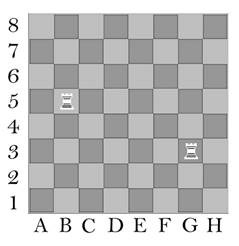
If I ask you, which rook can go to f5, then it is this square (point to f5) that one of the rooks should go to. You can then answer. "It is the rook on b5 that can go to f5 instead of something more obscure."
Chess leader's page
Teaching (At the demonstration board)
1. The Knight and the Queen
Now we'll look at the knight.” (Put up a knight in the middle of the demonstration board and show
the knight's movement pattern.) ”The knight walks like an L. Two steps forward and one to the side. You can also say that the knight should jump over a ditch and change the colour of his square when it lands. The knight is the only piece that can skip other pieces. Now I wonder if anyone can come forward and help me.” (Set up the following stand.)
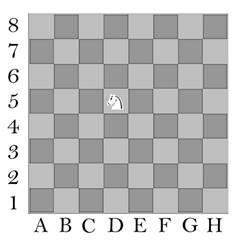
Can anyone put black pawns on the squares where the knight can jump? (Give the child / children 8 black pawns at hand. You can see the correct answer below.)
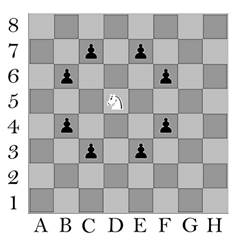
Good, Now we set up pawns around the knight, like this:… ”
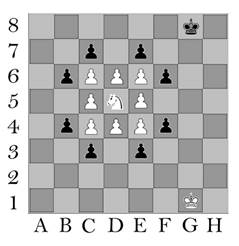
”… Even now, the knight can jump over and reach his squares. An important thing with the knight is that it has to perform its entire move, it cannot choose to stay on the road like the other pieces we watched.
This is the queen:
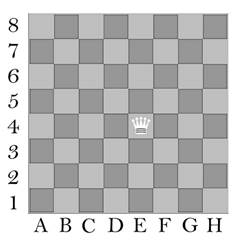
It is the best piece, because it combines the way the rook and the knight go. That is, how far it wants vertically, horizontally and on the diagonals. (Feel free to show with your arms) A queen standing on one of the center squares can actually go to 27 different squares. Come on, we'll add up.
Play
Queen against 8 pawns
Now we will play two mini-games: Ladies against 8 pawns and the Disco duel. Queen against 8 pawns works like this.
White wins if a pawn reaches the other side, the eighth row, without it being hit directly by the queen. Black wins if the queen takes all the white pawns. White starts as always.
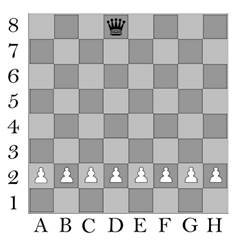
Exercise (Put up the position below on the demonstration board)
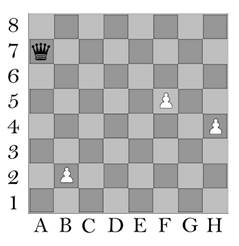
Answer: The only move that threatens all three pawns at once is Da7-f2.
Disco duels
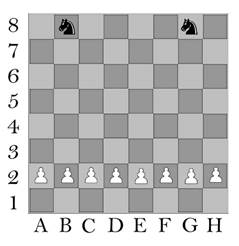
When you play the disco duel, you do it twice. Once with white and once with black. It is for whites to come over to the other side with as many pawns as possible without being able to be beaten directly. The knights try to take as many pawns as possible. When a pawn reaches the other side, without being able to be hit directly, he is safe and gives points. You use the small result card that comes with this exercise.
The reason why this exercise is called the Disc Duel is that the chess teacher Boris Bruhn, from Hamburg, usually frames the whole thing with a fairy tale:
“In a small German town, there would be a big party with a disco. Eight pawns wanted to go, but they had the wrong clothes and no VIP card. In the door of the disco stood two tough guards, two knights, so what would they do? They really want to go, and in the end, they decided to run towards the disco so that as many of them as possible would get in. They started running towards the entrance… How many pawns can you get into the disco?”
Teaching: How are the pieces put in the starting position? (At the demonstration board)
"Before you can play with all the pieces, you have to learn how the pieces should stand when you start a game." (Arrange the starting position of the chess pieces on the demonstration board as you explain.)
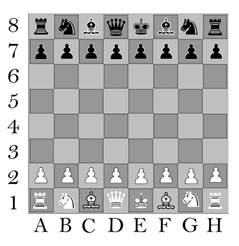
“The first thing you need to do is make sure that the board is in the right position. You should always have a white corner square on the right when you play, whether you are white or black.” (Point to h1 and a8. Also illustrate what follows by pointing.) “In addition, white pieces must always be on the ranks marked with the numbers 1 and 2. Black pieces must be on ranks 7 and 8. When I have to set up the pieces I start with the pawns, on rank 2 for white and rank 7 for black. Behind the pawns, I always start with the rooks in the corners. Then I usually think of the top of the rook as a bowl, and the knight is the one who needs to drink water from it, so they should stand next to the rooks. Then come the knights. When it comes to the position of the ladies and kings, the rule is that 'white queen must stand on a white square, and black queen on a black square'. The queens and kings shall stand opposite one another. If the board is correctly so that white is on 1 and 2, you can also think that the ladies should be on the d-line. D as in Dam. If you are still unsure, you can always look at the demonstration board or in the brochure 'The Chess Rules.'
"Now you can sit in pairs at the game tables and line up the pieces in the starting position." (Look at that that everyone got the right starting position.)
"Then it's time to play. The winner is the one who takes the opponent's king. Shake hands and get started.”
Rounding
When there are five minutes left in the lesson, tell the children to pack up and put the pieces in respective box.
When they are ready, everyone gathers at Meeting place.
Tell me, like a "cliffhanger", that next time is the first time they get to test programming.

