Checkmate – Kiss mate and Scholar’s mate
Material
Whiteboard pen
Lesson overview
5 min Introduction (Meeting place)
- Greet everyone.
- Tell what is going to happen during today's lesson.
- This week's anecdote (Chess language)
20 min Teaching (Demonstration board)
- Kiss mate
- Scholar’s mate
- Defence against scholar’s mate
30 min Tasks
- The Soviet secret
5 min Rounding (at the Meeting place)
- Let the children put the chess pieces in the boxes.
- Collection at the round table.
- Tell that next time will be the first check mate / programming lesson
- Hello then until next week.
The weekly anecdote
The language of chess
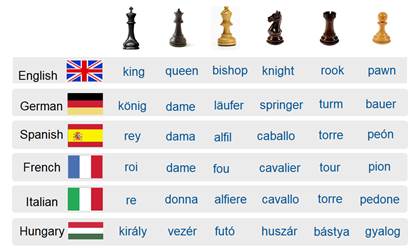
There are over 7,000 different languages in the world. But there is one thing that is the same all over the globe: the language of chess. First, chess is played in the same way in all countries. There are rules that everyone has accepted. This means that wherever you go, you can go into a café, bring a chessboard, set up the pieces and wait for an opponent. You can communicate with everyone. In addition, the chess moves are written down in the same way all over the world, using the coordinate system. What can differ is what the pieces are called and what initial they get, but if you know them you can read the features. This is how it works:
A white move and a black move, count as a full move. There are two ways to write down the chess pieces, either with a long notation or with a short notation. Long notation means that you write the box the play is on and the box the play goes to. With a short notation, you just write down the box the play ends up on.
When you write down a chess move, you start with the number of the move in the game. Then the initial (first letter) of the piece being moved, then the box it was on and finally the box it ends up on. Between the boxes you write a line (-) if it is a regular move. If you hit something with the move, you write an x. If the opponent ends up king in chess with the move you make, you write a plus (+) after the move. If it becomes check mate, you write mate after the move.
This is how to write down the Scholar’s mate with a long notation:
1. e2-e4 e7-e5
2. Bf1-c4 Bf8-c5
3. Qd1-h5 Ng8-f6
4. Qh5xf7 mate
When it comes to the names of the pieces, you can often connect different language groups. An interesting detail is that the English names have a clear connection to the feudal society in the Middle Ages where the king and queen ruled, where the government (rook) supported, as well as the church (bishop), the nobility (knight) and the peasants (pawns).
Teaching (Demonstration board)
Kiss mate
Now we'll learn the most common way to checkmate, and that's when the queen stands right in front of the opponent's king and is guarded. It's called a Kiss mate. Why? Well, there is a little fairy tale that tells that a queen wanted to kiss the opponent's king but was nervous that he did not want to. She needed someone to hold her hand as she kissed him. Luckily, she had many friends, and everyone was willing to hold her hand.
Now we look. In this position, the queen must stand on g7 to stand right in front of the opponent's king.
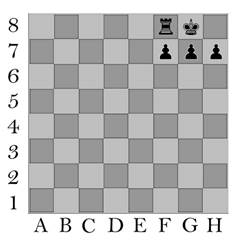
Then there will be another play that guards the queen. For example, like this:
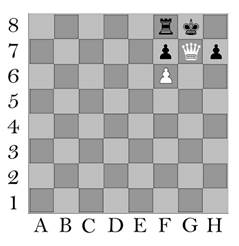
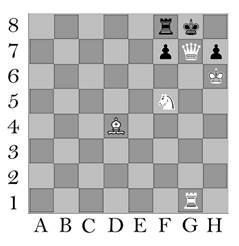
The white queen is standing right in front of the black king. The pawn on f6 guards the white queen, therefore the black king cannot beat the white queen, because then it ends up in chess. The king cannot run away, and it is not possible to put anything between the queen and the king. It's check mate. Here you can see how the other pieces can guard a queen on g7.
Scholar’s mate
There is a special variant of Kiss mate called Scholar’s mate. It is one of the most dangerous tricks when starting a chess game.
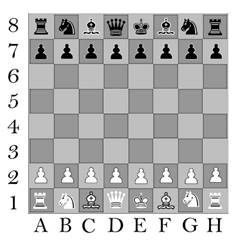
When starting a chess game, white and black have their weak points. Point f7 for black and f2 for white. The reason is that these peasants are only guarded by the king. What you aim for at Scholar’s mate is a Kiss mate at f7. White starts by playing 1.e2-e4 then 2.Lf1-c4 and 3.Qd1-h5.
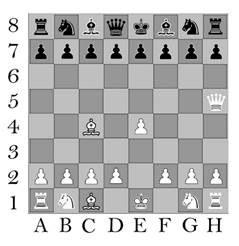
In its fourth move, white can then play 4. Qh5xf7.
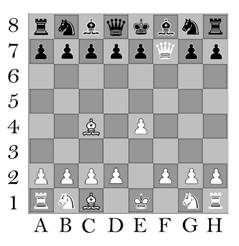
Now white has got his Kiss mate. The bishop on c4 guards the queen on f7, so black cannot beat the queen. The king cannot escape, and it is not possible to put a play in between.
An ordinary party usually goes like this:
1.e2-e4 e7-e5
2.Bf1-c4 Bf8-c5
3.Qd1-h5 Ng8-f6
4.Qh5xf7 mate
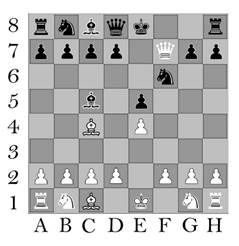
Defense against Scholar’s mate
But if you play black, how do you defend yourself against Scholar’s mate?
The critical thing is in this situation.
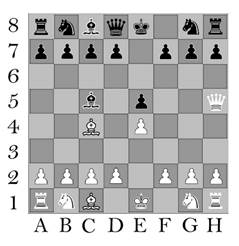
Now white is ready to hit with the lady on f7 and it would be mate, but it's black move. How can black avoid the mate? Maybe you want to prevent the lady from reaching f7 with g6.
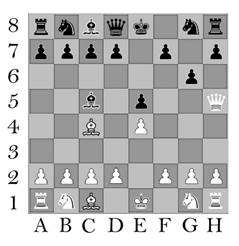
Now white is ready to hit with the queen on f7 and it would be dull, but it's black move. How can black avoid mate? Maybe you want to prevent the queen from reaching f7 with g6
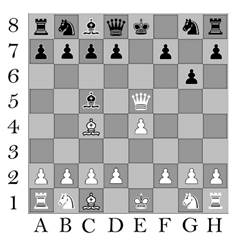
Now the white queen give check to the black king, and at the same time she is threatening the tower on h8 and the bishop on c5. White wins material.
Then you can guard the f7 pawn with the knight on h6.
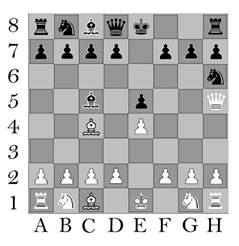
Now the queen cannot touch f7 because the bishop can then touch the queen. But again, the problem is that the queen can hit the e5 with chess.
A better way to guard f7 is to play 4… Qd8-e7, which guards both the f7 pawn and the e5 pawn. It's a good move, but even sharper is playing 4… Qd8-f6.
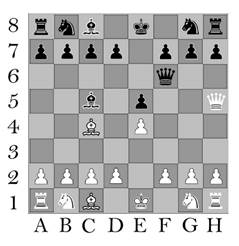
The queen on f6 now guards the f7 pawn and the e5 pawn, but it also threatens down on f2. The white weak pawn. 4… Qd8-f6 is a good move.
Tasks
The Soviet secret
Let the children work in pairs with a chessboard and pieces.
"When the Communists took power in Russia in 1917, they wanted to create a completely new society, the Soviet Union, and of course they wanted to show that this society was the best with the smartest people. How to do it? They bet on chess, the thinking game number 1. They paid for professional coaches around the country and soon they dominated the chess world. Most of the world champions have since also come from the Soviet Union. But how did they train? How could they be so good? All the chess coaches in the West wondered. In 1991, the Soviet Union collapsed and the coaches from the West got the chance to go to the Soviet Union. They wanted to know the secret!
The coaches from the West talked to the Soviets. But they had no secrets to reveal, they just said it was hard work. The coaches from the west were on and wanted so badly that there would be a secret. Finally, one of the Soviet coaches said a little tired that there was a secret: that you should talk to your players. You should ask them where they want to go, and if you are good at understanding the pieces, they will answer…
The coaches from the west did not understand what they meant. It sounded rather strange, but then they got some information that would explain what they meant.
The Soviet coach said that first you must understand how the pieces do NOT want to stand.
Now you put the white pieces, besides the peasants, next to an empty chessboard.
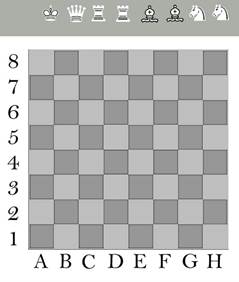
Now you should display the pieces on the board so that they can make as few moves as possible. Think of the Long Distances and the Melee Pieces, and which pieces can make many and long moves, and where on the board you should place the pieces.
An extra spice to this task: "It is said, from an unconfirmed source…, that those who apply to the CIA (Central Intelligence Agency, US security police,) do an intelligence test where this and the next task is included. If you manage to place the pieces so that they can make a maximum of 12 moves, you get a bonus star, which marks that you are smart enough to be the boss of all agents…” (Feel free to coach the children by walking around and showing that the pieces should stand in a corner and that the melee pieces should cover the long distances)
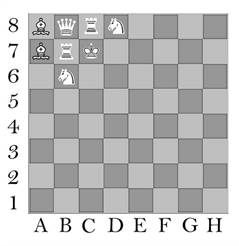
Answer
First, the melee pieces must put a stop to the long distances as much as possible. Then you should lump the pieces together in one of the corners. If you, do it well, you can come down to only 10 possible moves. Like this:
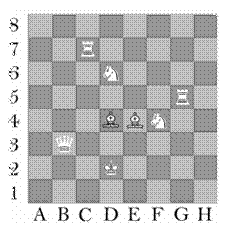
Now you know how the pieces do NOT want to stand. But we want to know how they WANT to stand. Therefore, you should now place them out so they can make as many moves as possible. A trick is to avoid the pieces hitting each other, that they stand free, so that they can make as many moves as possible. Also keep in mind that the closer to the centre the queen and the bishops are, the more moves they can make. However, a tower can always make 14 moves regardless of placement on the board.
If you manage to place the pieces so they can make 88 moves or more, you again get a star next to your name by the CIA. (Feel free to walk around and show that the pieces do not collide, that they are as close to the centre as possible.)
Answer
Here is the position where the pieces can make the maximum number of moves: 100.
Play
If there is time left over, let the children play a real game of chess, with judgment.
Rounding
• Have the children put the chess pieces in the drawers.
• Collection at Meeting place.
• Tell us what happens next
• Hi then until next week.

