We play tournament
Preparations
- Choose the three best minigames that the children invented last time
- Copy a piece of paper with the name of all the minigames you played during the semester + the three that you selected for today's tournament.
- Prepare all-play-all-tables for students. (1 table for four students. Cut out the tables below.)
- Prepare diplomas for all children!
- (Possibly bake the cookie Chess boxes for the children in the group)
Material
- Whiteboard pen
- A copy with all the minigames to each child
- All-play-all tables
Lesson overview
5 min Introduction (Meeting place)
- Welcome everyone.
- Brief summary of what happened last time.
- Tell what is going to happen during today's lesson.
- Anecdote of the week: When the computer defeated man
45 min Games
- Presentation of "All-play-all table".
Divide the children into four.
- Presentation of the minigames invented by the children and to be played. Present them one at a time before the three rounds begin.
10 min End
- Award ceremony where everyone gets a diploma (Possibly with serving of cookie chess pieces)
Back-up games for the tournament
1. The hand and the brain
2. Chess in pairs
3. Bughouse
Chess Squares Cookies
Ingredients
4.5 dl wheat flour
1 dl sugar
200 grams of butter, at room temperature
2 tablespoons cocoa
1 tablespoon water
Cooking
100 pcs small or 50 pcs large.
1. Combine flour, sugar and butter by hand or with a food processor. Remove half of the dough and add cocoa and water and process until the dough is browned.
2. Put the dough in two plastic bags and let them rest cold for at least 30 minutes.
3. Set the oven to 200 degrees.
Roll out the dough into two light and two dark even lengths. Place a candle next to a dark one and change places on the colours in the next layer. Press the lengths together to form a square. Cut into 5 mm thin slices. Lay them out on a sheet of baking paper.
Bake in the middle of the oven for about 8 minutes. Let the cakes cool on the baking paper on a wire rack.
The weekly anecdote
When the computer defeated man
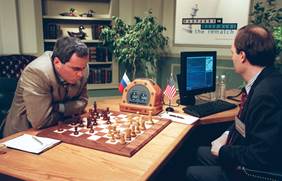
Today, the computer is better than man in chess. Even a smartphone has chess software that can beat the world champion. The computer that was the first to do so was the Deep Blue supercomputer in 1997.
In the early 1950s, the first steps were taken to create a chess computer. It soon became a race between different computer companies. Everyone wanted to show that their company could produce a computer stronger than humans. The reason is that chess intelligence game No. 1, and therefore there was a lot of prestige in this. The company that led the development was IBM and in the early 1990s, computers began to become so powerful that it was understood that it was only a matter of time. In 1997, a match was organized over six games between the world champion, the fantastic Russian Garry Kasparov, and IBM's supercomputer Deep Blue. It was even and before the last game it was 2.5-2.5. In the last game, the computer makes a move that has never been seen before from a computer. Quite frankly, "a human trait", which cannot be calculated as computers usually do. Kasparov lost the game and the match. Immediately after the match, IBM scrapped its project with Deep Blue. They had proved what they were supposed to. But since then, there have been lots of strong chess programs and all chess players today train with computers.
Deep Blues hardware filled an entire room

Today, a telephone is stronger and more advanced

All-play-all-tournament
An all-play-all tournament means that all participants in the tournament must meet each other. Four participants mean three rounds, and six participants means five rounds, and so on. This is a form of tournament used in both beginner training and world elite.
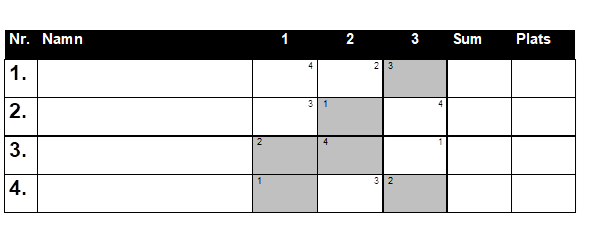
When playing an all-play-all tournament, you use a pre-printed table, in which you enter the names of the participating children. The table then determines who meets in each round and ensures that everyone gets as even a distribution as possible when it comes to games with black and white respectively. The most common in chess training is that you divide the children into four so that you can play three rounds of chess during the training. Of course, you can also have a tournament with all the children in the group that runs throughout the semester.
It is usually a good idea to copy several sheets with the table you most often use, so that a table is always easily at hand.
In an all-play-all tournament with four participants, there will be three rounds. Do this:
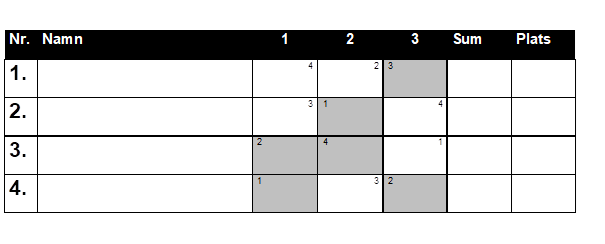
Enter the names of the participants in the tournament under the heading Names. The small number inside the round windows shows who you meet, and what colour you are. If the small number on the right in the round box is the player is white, if the small number on the left is the player is black (grey box). In the first round, No. 1 is white against No. 4 and No. 2 is white against No. 3. It is good if the tournament leader reads out who meets before each round and then clarifies who is white and who is black.
Back-up games for the tournament
Divide the children into pairs, who play the tournament together.
The hand and the brain
A regular game of chess is played, but you play in pairs. One sits at the board, in the usual way, the other in the team stands behind his partner and looks down at the board. The one behind it is the "Brain". The one sitting down is "The Hand". They meet another team that is placed in the same way on the other side of the table. When a move is to be played, "The Brain" says, which is behind the type of play to be moved (ie King, Queen, Tower, Bishop, Knight or Pawn.). It is ONLY one of these six words that the Brain is allowed to say. Then the Hand chooses where each piece should go, or if there is more than one piece of the same type (towers, bishops, knights or pawns), the Hand also chooses which one to move.
Chess in pairs
A regular game of chess is played, but you play in pairs. Two players sit in front of a board and face another team. The two players in the team make every second move. (You can choose whether they are allowed to discuss with each other or not during the game. Usually it is actually best if they do not discuss, as it is easy for someone to decide all the moves.)
Bughouse
A regular game of chess is played, but each team consists of two players. They sit next to each other, each with their own board in front of them. On the one hand, one player in the team plays white, on the other, the other player plays black. When a player in the team hits a piece, he gives this piece to his teammate, who can choose to either make a regular chess move on his board, or to insert one of the pieces "you have on hand". If there is a checkmate on one of the boards, both games are over immediately. You can insert a piece, so it becomes a checkmate. However, you cannot insert a play and take another play.
Completion and diploma award

